Poker Equity: How to Calculate Hand and Fold Equity
Here is the assumption most players never name: a hand doesn't have a single value, it has a share. Poker equity is that share — the percentage of the pot your hand or range is priced to win if the deal ran to the river a thousand times. I spent years pricing uncertainty for a living, first in actuarial tables, later on a sports betting book, and the habit sticks: a number that can't be turned into a decision at the table isn't worth carrying to it. If you already know how to weigh a call against its price, this piece covers something else — how that win percentage gets built, and denied. For the call-price math itself, see our pot odds guide; some players run equity live with tools like NZT Poker, one option among several, though that category has tradeoffs worth knowing first.
Poker Equity Definition: What the Number Actually Prices
The poker equity definition in one line: it's the probability your hand wins the pot, expressed as a percentage, given the cards left to come. Flip that into odds and it's roughly 2-to-1 against for a 33% hand, or about 33 times per 100 deals. I'll give figures in percent, odds, and times-per-100 through this piece, because each answers a different question a player actually asks.
Equity is not the same as pot odds, and it's not the same as expectation. Pot odds price the call you're facing right now; equity prices the hand independent of any bet. Expectation multiplies equity by the pot to price a decision — it never forecasts an income, and I won't use it that way here.
How to Calculate Poker Equity by Hand
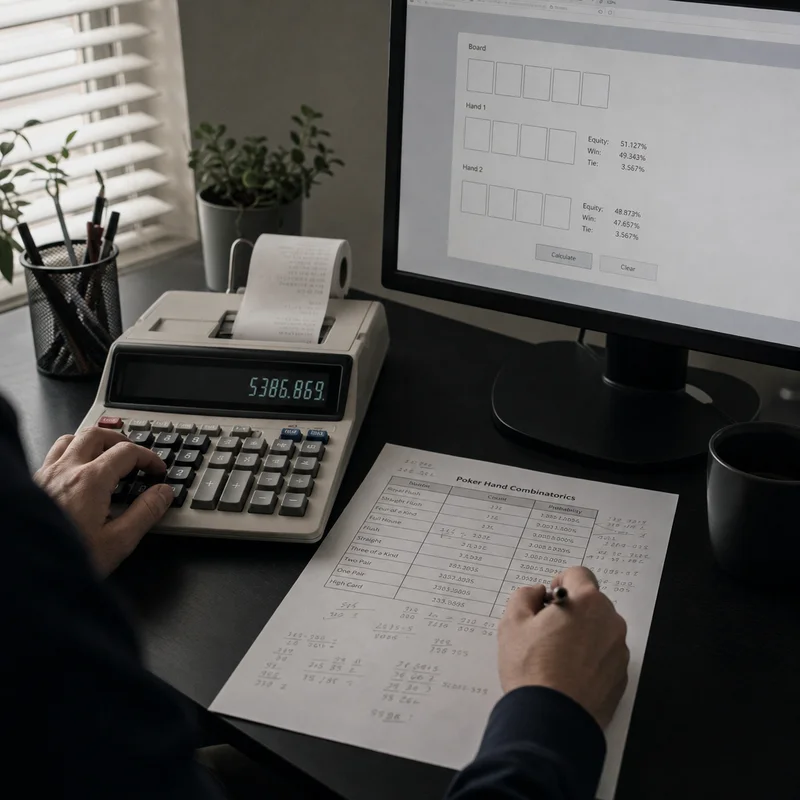
The textbook way to calculate poker equity is exhaustive enumeration: run every possible combination of remaining cards, count how many your hand wins, divide by the total. That's what a solver or an equity calculator does in milliseconds. By hand, you don't need exhaustive counting — you need the rule of 4 and 2.
- Count your outs — the cards that improve your hand to a likely winner
- With two cards to come, multiply outs by 4 for an approximate equity percentage
- With one card to come, multiply outs by 2 instead
- Adjust down slightly for outs that might also improve an opponent's hand
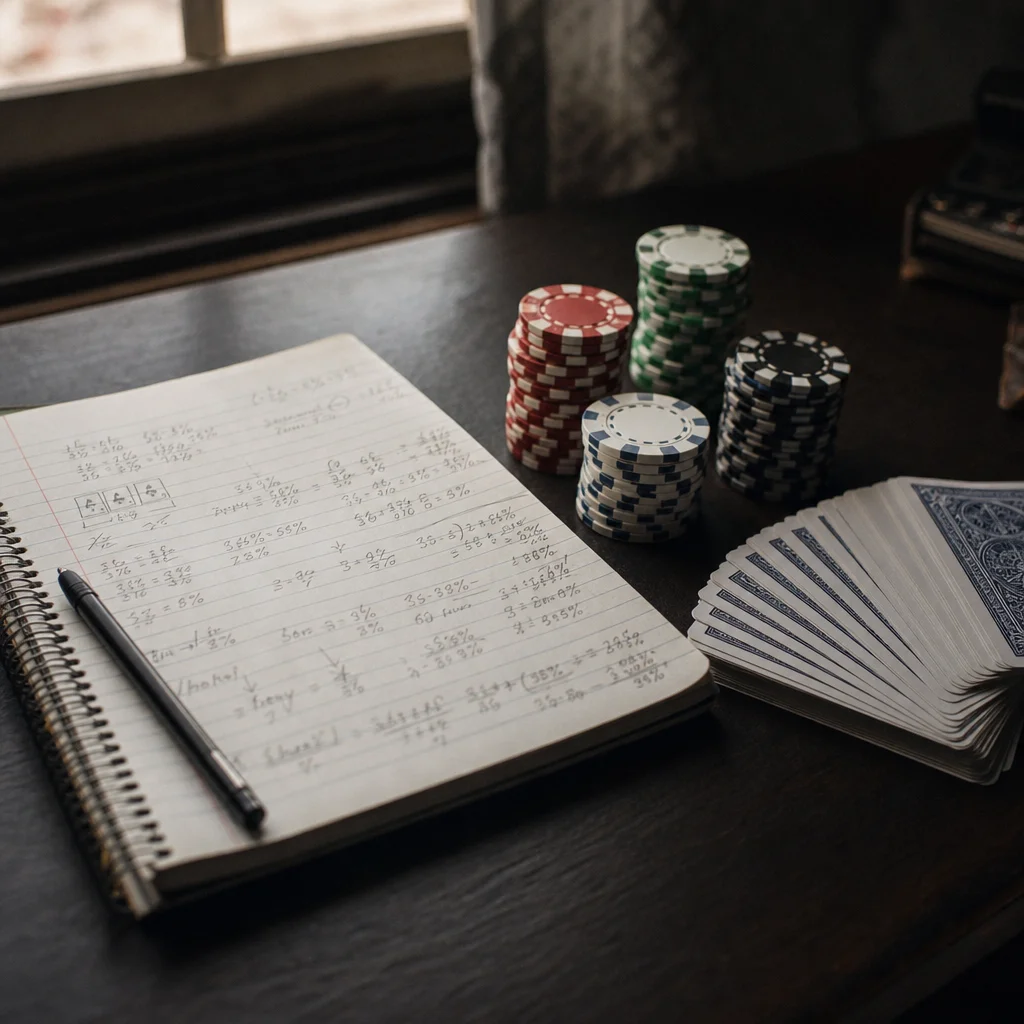
Take a flush draw on the flop: 9 outs, times 4, gives roughly 36% equity — call it 1.8-to-1, or a make about 36 times per 100 hands. The real enumerated figure is closer to 35%, so the shortcut overstates equity slightly as out counts climb past 8 or 9. Round it down a point or two on bigger draws and move on.
Hand Equity vs. Range Equity in Poker
A single hand's equity is a clean number. Range equity is messier, because a range is a distribution, not a point — your opponent isn't holding one hand, they're holding a weighted mix of everything consistent with how they've played the pot. This is where a poker equity chart earns its place: it lets you see how poker equity is spread across your entire holding, not just the specific two cards you happen to have.
Reading Poker Equity Buckets
Practitioners sort a range into poker equity buckets — strong made hands, draws, and air, roughly speaking — because averaging the whole range into one number hides its shape. A range that averages 45% equity could be all mediocre hands, or a polarized mix of near-locks and total bluffs. Same average, different plan for the next street.
| Bucket | Share of Range | Average Equity |
|---|---|---|
| Value (top pair+) | 30% | 78% |
| Draws / marginal | 25% | 41% |
| Air / bluff candidates | 45% | 9% |
That table is illustrative, not a universal split — actual shares shift with position, stakes, and runout. But the discipline transfers everywhere: a mistake priced against the wrong bucket average is a mistake priced against a number that never existed. Solvers resolve this at equilibrium across every bucket at once; that's deeper than one article covers, and our solver guide handles the equilibrium side properly.
What Is Fold Equity in Poker?
Fold equity poker math answers a question hand equity can't: what do you gain from the chance your opponent simply folds? Hand equity assumes the deal runs to the river. Fold equity accounts for the more common case — the hand ends early because a bet won the pot outright, regardless of who was ahead.
Here's how to calculate fold equity poker style: multiply your opponent's estimated fold percentage by the pot you'd win uncontested, then add your hand equity's share of the money still in play. A bluff that works 40% of the time — 2-to-5 against being called, roughly 40 times per 100 attempts — doesn't need much backup equity on the other 60% to be profitable.
Poker Bluff Equity and Pricing a Semi-Bluff
Poker bluff equity is fold equity's applied form — the case where you're betting a hand currently behind, priced on “they might fold” plus “I might improve anyway.” I'll price a mistake rather than describe it: betting pure air with zero fold equity and zero backup equity loses the full pot every time it's called — 100bb per 100 such bets at 1bb units, a number that argues for itself.
Pro Tip
Equity Denial: Betting to Protect a Lead
Equity denial flips the fold-equity logic around. Instead of betting to make a worse hand fold when you're behind, you're betting to make a hand with real poker equity fold while you're ahead. A pair of jacks facing two overcards on the turn isn't just protecting the pot size — it's removing the 20-25% equity share those overcards were carrying toward the river, at a price the opponent has to pay to keep drawing.
I've found this is the concept players understand but under-price in practice. A draw denied its equity by a fold scores zero instead of its true 20-40% share — multiply that swing across a hundred similar spots and it's the gap between a marginal winrate and a solid one.
Poker Equity Drills to Build the Skill
Reading equity numbers is one skill; producing them under time pressure is another, built only through repetition. A short rotation of poker equity drills closes that gap faster than reading about it.
- Deal 10 flop textures and estimate equity vs. a single hand before checking a calculator
- Sort one range vs. range spot per session into value / draw / air buckets before running the number
- Price 5 semi-bluff spots by fold equity plus backup equity, then compare to a solver output
- Track your estimate against the calculated figure, noting the direction of your error
That last point matters more than it looks. If your estimates run high on draws, you now have the correction to apply live, without a screen open at every decision. For a live number instead of a mental shortcut, a probability calculator inside a real-time aid such as NZT Poker's GTO Poker Bench does that calculation for you — worth knowing about, though it's worth weighing against solver study and the account-risk profile such tools carry.
Common Equity Mistakes and Their Price
- Estimating equity in buckets, not one blended average, prices bluffs and value bets more accurately
- Factoring fold equity into semi-bluffs turns marginal bets profitable without needing a strong hand
- Practicing quick estimates builds a live feel that holds up without a calculator on hand
- Rule-of-4-and-2 shortcuts overstate equity on larger draws by a point or two uncorrected
- Treating a wide range's average as one hand's equity misprices both value and bluffs
- Relying entirely on a live assistance tool during play carries its own account-risk tradeoffs
Each mistake has a price, not just a description. Overstating a big draw by 3 points across a hundred similar bets is a small, steady leak. Misreading a polarized range as one average number is a larger one — it shows up on every street of every hand that range appears in. Neither announces itself, which is why the drills above ask for direction of error, not just whether you were right.
Want to Check Equity Live?
If you want a live pot-odds and equity readout during play, NZT Poker is one option worth exploring.
See NZT Poker's CalculatorDisclosure: This page contains affiliate links. We may earn a commission at no extra cost to you.