
GTO Poker: Complete Guide to Game Theory Optimal Play
GTO poker means playing an unexploitable strategy — one built on game theory optimal principles so no opponent can beat you regardless of how they adjust. You already know your ranges and betting rounds, so let's skip the primer and go straight to what actually matters: equilibrium logic, mixed strategies, and the moment where deviating from GTO beats sticking to it. That last part is the one most guides skip, and it's the one that separates a player who quotes solver output from a player who wins with it.
Some players like to sanity-check a live spot with a probability tool while they're studying — the equity calculator inside NZT Poker is one option people use this way, though it's worth knowing upfront that this class of software also offers in-hand action suggestions, which most rooms treat very differently than a study tool. More on that trade-off later in this guide.
What Equilibrium Actually Means at the Table
An equilibrium strategy is one where no single change you make improves your result, assuming your opponent also plays their best response. In poker terms: at true GTO, if your opponent knew your exact strategy in advance, they still couldn't find a change to their own play that wins more money against you. That's the whole idea in one sentence — nobody can punish you for being predictable, because there's no exploitable pattern left to find. Here's the drill setup you'll want to hold onto: you open-raise the button with a range, and a solver tells you to bet 75% of the pot on a certain flop with your whole range, not just your strong hands. Why bet weak hands at the same size as strong ones? Because if you only bet big with strong hands, an attentive opponent folds everything except the hands that beat you — and now your strong hands get no value. Equilibrium forces you to bet a range, not a hand.
A quick way to spot when you're drifting from equilibrium thinking without realizing it: if you catch yourself betting only your strongest hands for maximum value, stop and ask what happens to those same strong hands next time, against an opponent who's noticed the pattern. Equilibrium isn't about being sneaky — it's about making your strong hands and your bluffs indistinguishable at the moment of decision, so the only information your opponent has is the size and the street, never the hand.
Mixed Strategies: Why the Same Hand Gets Two Different Actions
Mixed strategies are the part of gto poker that confuses most players moving from exploitative thinking into gto poker basics. A solver might tell you to bet a hand 60% of the time and check it 40% of the time — same hand, same spot, two different actions. That's not indecision. It's the frequency that keeps your opponent from ever knowing which action means what. I collapse this for my students into one always-do rule: if a solver mix leans 70/30 or sharper, round it to the dominant action and drop the minority frequency entirely. Here's what that shortcut costs you — a small amount of pure GTO equity, usually a fraction of a big blind per hundred hands, in exchange for a decision you can actually make at 2am on four tables. A mix you can't execute isn't defending anything. Quick drill: you're facing a 55/45 mix on the river. Do you round it, or play the mix? Hold that answer — we'll come back to when mixing matters more than simplicity a few sections down.
The Simplification Rule
GTO vs. Exploitative Poker: Two Different Jobs
GTO exploitative poker is really two different jobs, not two competing philosophies. GTO is your defense — it caps how much any single opponent can win off you no matter their strategy. Exploitative play is your offense — it targets a specific, observed leak in a specific opponent to win more than equilibrium would ever claim. The answer to the drill above: at 55/45, play the mix if you have a reliable randomizer (second hand on the clock, card suit, anything not memorized) and the pot is large. Below that threshold, round to the majority action — the cost of simplifying a close mix is smaller than the cost of misexecuting a mix you can't track under pressure. Exploitative deviation only earns its place when three things line up: you've observed a real pattern across enough hands to trust it, you know the leak by name (folds too much to river aggression, overfolds the turn, never check-raises without the nuts), and you know what the deviation costs if you're wrong about the read. A deviation with no named leak and no stated downside isn't an adjustment — it's a guess wearing a strategy's clothes.
Think of it as two separate skills you're building at once. GTO study teaches you the shape of a balanced range — how many bluffs a given bet size needs, how wide a range should defend against a given sizing — and that shape becomes your reference point. Exploitative play then tells you when to lean away from that reference point on purpose, because the specific human across the table isn't playing anywhere near equilibrium themselves. Neither skill replaces the other; a player with only GTO study can't find the extra money sitting in a bad player's obvious tendencies, and a player with only exploitative instincts has no stable baseline to fall back on against a tough, unknown opponent.
| Dimension | GTO (Equilibrium) | Exploitative |
|---|---|---|
| Goal | Cap opponent's max win rate against you | Maximize win rate against a specific tendency |
| Best used against | Strong, unknown, or solver-aware opponents | Weak or predictable opponents with a named leak |
| Risk if wrong | Low — no read required | High — costs more than balanced play if the read is false |
| Sample size needed | None — holds by construction | Large enough to trust the pattern isn't coincidence |
When Exploitative Deviation Beats GTO
This is where gto in poker theory and real-table results split apart, and it's the single most valuable thing in this guide. Pure equilibrium play assumes a perfect, game-theory-aware opponent. Almost nobody at your stakes is one. Against a population that overfolds to continuation bets, betting your entire range at equilibrium frequency leaves money on the table — you should be betting more often, because the "balance" equilibrium protects you against doesn't exist at that table. The honest cost accounting: if you deviate toward a population tendency and you're right, you gain more than GTO would have. If you're wrong — if the player you've profiled as a folder turns out to be slow-playing a real hand — you lose more than a balanced strategy would have lost. That's the trade every exploit makes, and any coach who tells you a deviation is free money is skipping the second half of that sentence. The practical rule I give students: exploit population tendencies (patterns true of most players at your stake) freely, because the sample size backing "most players at NL50 overfold the river" is enormous. Exploit individual reads (this specific opponent, this specific session) only after you can name the leak and you've seen it enough times that it's not a coincidence.
- Population-level exploits (most players at your stake overfold the river) — safe to use broadly, backed by large sample sizes
- Individual reads (this specific opponent, this session) — use only once you can name the leak and you've seen it repeat
- Blind deviations with no named leak and no stated downside — not an adjustment, just a guess wearing a strategy's clothes

GTO Postflop Strategy: Where the Logic Actually Shows Up
GTO postflop strategy is where equilibrium logic actually shows up in your decisions, because preflop ranges are close to solved and memorizable, but postflop trees branch too fast to memorize. Board texture, stack depth, and position all change the correct bet size and frequency, which is why postflop is the layer where understanding the logic beats memorizing an output. Three postflop concepts carry more weight than any chart: bet-sizing shifts with equity distribution, not hand strength alone — a range with a big equity edge but few strong hands wants a smaller, more frequent bet; range advantage narrows fast on later streets, so a range that was ahead on the flop can be behind by the river even with no new draws completing; and check-raising ranges are almost always narrower than betting ranges, because checking first gives up initiative you need a genuine edge to reclaim. On a dry, disconnected flop where your range holds the equity edge, that logic usually points toward a smaller, more frequent bet rather than a big one reserved for your best hands only — the dry texture doesn't threaten your edge on future streets the way a wet board would.
GTO Poker Positions and Why Ranges Change by Seat
GTO poker positions matter because equilibrium ranges widen or tighten based on how many players can still act behind you, and how much information you'll have for the rest of the hand. Early position ranges stay tight because more players can wake up with a strong hand behind you. Late position ranges widen because you'll have position for every remaining street, and that positional edge is worth real equity on its own. Position also interacts with the postflop sizing logic from the section above — a range advantage matters more in position, because you get to see how your opponent reacts before committing more chips. I won't walk through full positional charts here — memorizing opening ranges by seat is its own discipline, and our preflop ranges guide covers the position-by-position breakdown in the depth it deserves. Use gto poker charts as your starting point, not your finish line; the chart tells you what to do, this page tells you why.
How to Learn GTO Poker Without Wasting a Year
Players asking how to learn gto poker usually start in the wrong place — they open a solver before they understand what question they're asking it. A solver answers "what is the equilibrium strategy in this exact spot," which is only useful once you already know why that question matters. Start instead with hand-reading: put your opponent on a range, not a hand, before you ever touch a solver output. From there, study small trees before big ones. A single-raised pot on a dry flop with 100 big blinds has a manageable number of decision points. A three-bet pot on a wet board with 40 big blinds effective does not — and starting there teaches you to memorize outputs instead of understanding logic, which is the exact trap mentioned earlier with mixed strategies. If you want structured gto poker articles and solved-spot databases to study between sessions, that's a reasonable supplement — treat any single source, including this one, as one input into your study, not the whole plan. Reading without playing teaches you vocabulary. Playing without reviewing teaches you nothing at all. You need both, on a schedule you'll actually keep.
Solvers, HUDs, and Real-Time Assistance: Three Different Tools
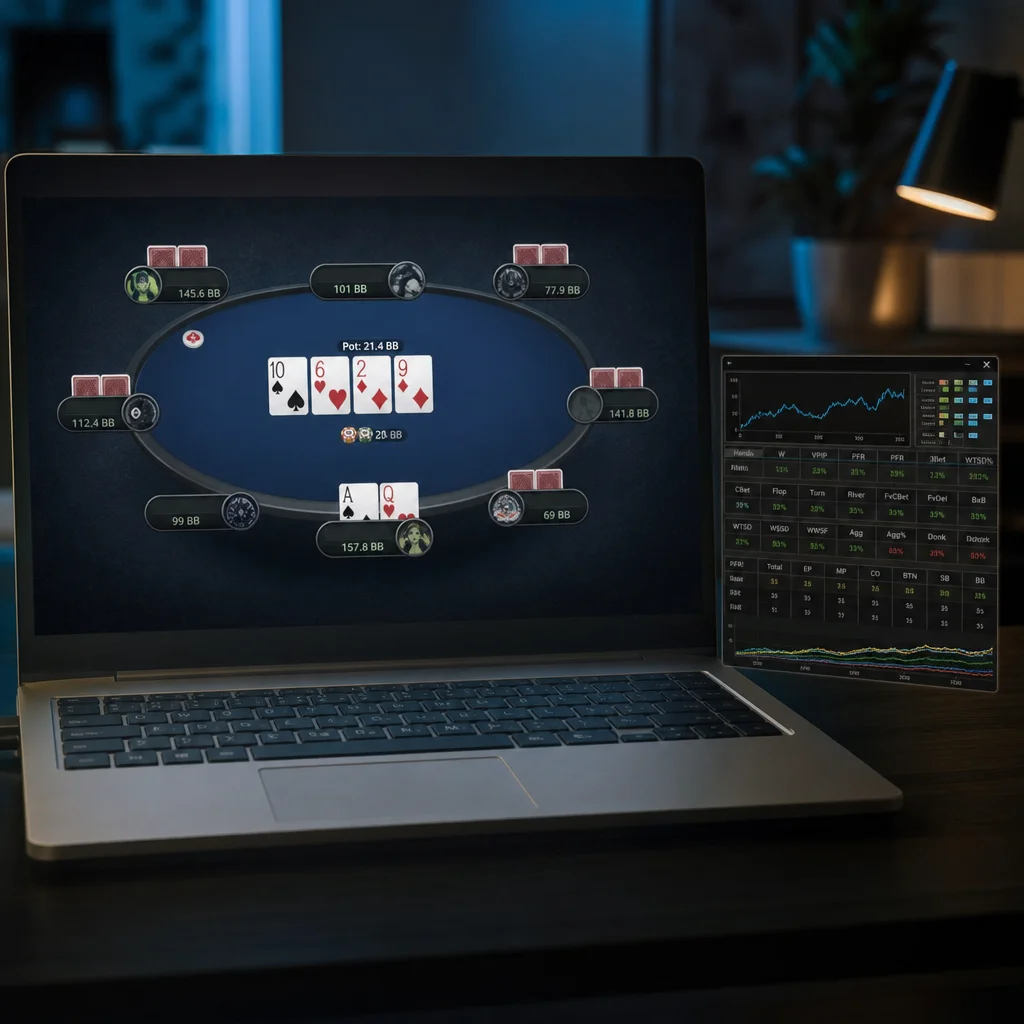
You'll run into three categories of tool while you study gto poker, and confusing them costs people real money and real accounts. Solvers like PioSolver calculate equilibrium strategies for a specific spot, away from the table, so you can study the output afterward — they're study tools, not table tools. Our poker solver guide covers how that software actually works and what it costs, if you want the deeper dive. HUDs like Hand2Note or DriveHUD display opponent statistics during play but leave every decision to you; they're legal on any room that permits third-party software and they build the pattern-recognition skill this guide has been describing all along. Then there's a third category: real-time assistance software that reads the live hand and hands you a suggested action — fold, call, or raise — while you're sitting at the table. If you want to see what that looks like in practice, NZT Poker's GTO bench tool is one example, built for the Asian club-app ecosystem (PokerBros, PPPoker, and similar platforms) rather than for regulated Western rooms. It's a fundamentally different trade than the first two tools: you're not building skill, you're renting a decision, and real-time assistance is banned by the terms of service of essentially every platform it runs on — PokerBros tightened enforcement against exactly this kind of software in 2025. If you're deciding between these three categories, you're choosing a risk profile, not a feature set.
GTO poker is a defensive floor, not a winning formula on its own — it caps your losses against unknown or strong opponents, and exploitative deviation is where the extra money actually comes from against weaker ones. The players who improve fastest at gto poker treat solver study as a way to sharpen their read on why a line works, then simplify that logic into something they can execute at 2am, tired, on four tables, without pulling up a chart. That's the whole craft: understanding deep enough to simplify, not memorizing deep enough to freeze under pressure.
Want a Live Equity Read While You Study?
NZT Poker's calculator is one option worth exploring if you want a live pot-odds and equity snapshot alongside your solver study.
Explore NZT PokerDisclosure: This page contains affiliate links. We may earn a commission at no extra cost to you.