
Poker Solvers: How They Work and How to Study Them
A poker solver is software that builds a simplified game tree from the inputs you give it — starting ranges, stack depth, bet sizes — and calculates a strategy where neither player can profitably deviate. That's the whole machine. You already know why that target matters; what you likely don't have yet is a clean picture of how it gets there, and what to do with what it hands back. I've watched plenty of students stare at a solved tree with no idea which number to write down. If you want a guided way to drill the ranges a poker solver produces before you sit down again, NZT Poker's GTO Poker Bench is one option worth exploring — built for off-table practice, not use during a hand. (see Brown & Sandholm, Science (2019)).
What Goes Into a Poker Solver Before It Solves Anything
Every solve starts with four inputs: starting ranges, stack-to-pot ratio, the board, and available bet sizes per street. Change any one and you get a different tree — and a different answer. Most players skip past this detail, and it's exactly what makes solver output abstract rather than literal.
Restrict the bet sizes to one option per street and the solver works inside that fence — it finds the best strategy available within your constraints, even if a size you didn't offer would have solved the spot better. A poker solver never flags that it's missing an option; it just answers the question you asked. Drill: you set up a flop c-bet spot with only a 33% and 75% pot-size option, and the solver mixes between them. Does that mix tell you anything about a 50% c-bet? Hold that question — the answer is in the next section.
Node Locking: Turning a Poker Solver Into an Exploit Finder
Answer: no. A solver that never saw a 50% bet has no opinion on it — the mix you got was the best split of the two sizes you allowed, nothing more. That's the core lesson of any poker solver: the output only answers the exact question the tree was built to ask.
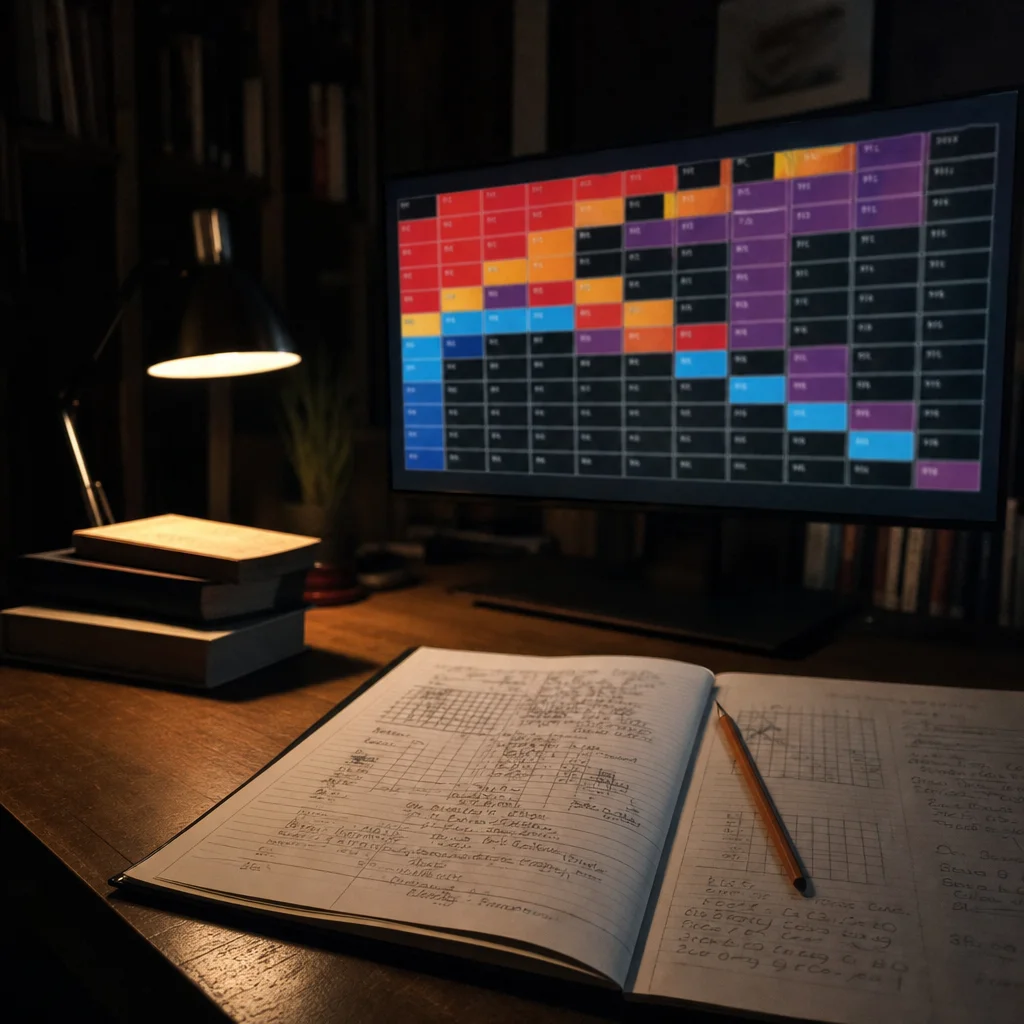
Node locking is how you turn that same machine toward a real opponent instead of a theoretical one. You freeze the strategy at one decision point — say, forcing the big blind to fold to a c-bet far more often than equilibrium calls for — and re-solve everything downstream against that fixed behavior. The common misconception is that a single node lock can be used to generate a maximally exploitative strategy — node locking is a process by which we force the solver to use a particular strategy at a specific decision node. It does not represent the true maximum; a better description is somewhat exploitative, since the solver still assumes perfect play at every node you didn't lock.
What Node Locking Costs You When You Get It Wrong
Reading Solver Output Without Drowning in Decimals
This is where most players lose the thread. A solved node hands you a frequency for every action, across every combination in the range — hundreds of numbers stacked together. Memorizing that grid is a losing game; frequencies shift with stack depth, sizing, and texture faster than live memory tracks. What you carry to the table isn't a decimal — it's a rule.
I don't quote a solver's frequency to two decimals from memory, and you shouldn't either — nobody executes that under four-tabling. What I take instead is the collapsed version: a 90/10 mix isn't a mix I play, it's an always-bet rule, and the 10% is the cost of simplifying, not a live threshold. A near-even split tells you something different — the actions are close enough that a texture-specific read should decide it, not the solver.
- Frequency above roughly 80-85% for one action → collapse it to an always-do rule and accept the small EV cost of the simplification
- Frequency near an even split → treat it as a genuine mix where your read on the specific opponent should tip the decision
- A sizing that never appears in the solved strategy → drop it from your live range of options entirely, it's not being missed
- A hand type the solver folds 100% of the time → stop bluff-catching with it, full stop, no exceptions carved in from memory
Building a Study Routine Around a Poker Solver
A poker solver is a research instrument, not a study plan — the plan is what you build around it. A routine that holds up over months looks like a rotation: pick a narrow spot, solve it, extract two or three rules, drill those rules until automatic, then move on. Trying to internalize an entire street's tree in one sitting is how students burn out within a month.
Start with spots you reach often — single-raised pots in position, common 3-bet pots at your stakes — before chasing exotic multiway trees. After every solver session, immediately test what you learned; active recall cements it far more effectively than passive review. For why the equilibrium target holds up under game theory itself, our GTO poker strategy guide covers that properly; this page stays on the tooling.
| Tool type | Used | Legal at table? | Skill that lasts? |
|---|---|---|---|
| Solver (PioSolver, GTO+) | Away from table | Yes — everywhere | Yes |
| Cloud GTO trainer | Away from table, for drilling | Yes — everywhere | Yes |
| HUD (Hand2Note, DriveHUD) | During play, stats only | Room-dependent | Partial |
| Real-time assistant (RTA) | During the hand, suggests action | No — prohibited | No |
That last row is the one players confuse with solver study most. A real-time assistant reads your live hand and tells you what to do in the moment — it isn't studying, it's substituting. That's a different product, a different risk profile, and a different rulebook.
Poker Solver Software: Free, Paid, and What You Actually Need
You don't need the most expensive poker solver on the market to build the habit. Free poker solver options exist — several cloud platforms offer a capped free tier, enough to learn node locking on real spots before you subscribe to anything. The cheapest poker solver path is a free tier plus a one-time desktop license once you outgrow the cap, not the priciest subscription available.
The bigger fork is desktop versus cloud. A desktop poker AI solver like PioSolver runs on your own machine and gives you full control over the tree — more setup, more hardware wait, no subscription ceiling. A cloud trainer, the category GTO Wizard occupies, pre-solves spots so you can query and drill them instantly through a subscription. That specific trade-off, and the pricing tiers involved, is exactly what our GTO Wizard breakdown is built to walk through — it's the better page for that comparison.
In my experience, the tool matters less than whether you run the routine above weekly. I've watched students with the priciest solver skip the drill step and retain nothing, while students on a free tier out-improved them in three months. Worth paying before you've proven you'll use the free tier? Usually not.
- Node locking lets you test a specific opponent tendency instead of guessing at the table
- A collapsed rule from a solved spot survives four-tabling in a way raw frequencies never will
- Free tiers on most platforms are enough to build the study habit before you spend anything
- Solver output is only as good as the ranges and sizings you fed into the tree
- Node locking without real opponent data just lets you justify a play you already wanted to make
- Desktop solvers demand real setup time and a machine that can actually run the solve
Where a Poker Solver Fits Against Other Tools
It's worth being precise about what a poker solver is not, because the category gets muddled online. It isn't a HUD — Hand2Note and DriveHUD display opponent stats live and leave the decision to you, a different job entirely. It's also not an in-hand assistant that reads the current hand and returns fold, call, or raise while you're sitting at the table. NZT Poker falls into that last category — built for use during the hand on supported club apps, not for the off-table study this page covers, and that distinction carries real account-risk consequences.
Are poker solvers legal? Yes, without qualification — a solver is used away from the table, before or after you play, and no room's terms restrict studying with one. That's a different legal position from any tool operating during live play.
A Realistic First Month With a Poker Solver
If you're picking up a poker solver for the first time, resist the urge to solve everything. Week one: pick five spots you play weekly and solve those. Week two: node-lock each against your most common opponent type. Week three: drill the collapsed rules until automatic. Week four: review hands you actually played and check whether you followed the rule or improvised — that gap is your real leak.
Want to Drill Solver Ranges Off the Table?
A structured way to practice the ranges and rules a solver produces, built for study sessions rather than live hands.
Explore GTO Poker BenchDisclosure: This page contains affiliate links. We may earn a commission at no extra cost to you.
Sources
- Pro Tips with James Sweeney: The problem with node lockingpoker.org
- How to Use a Poker Solver: Extract Actionable Insightsthinkgto.com(2026-05-14)