Poker Odds Explained: Complete Calculation Guide
Poker odds are a ratio: the number of cards that improve your hand against the number that don't. Nothing more mystical than that. Once you can count outs and turn them into a percentage at the table, you've done the hard part — what you do with that percentage against a bet size is a separate question, and I'll point you to the pot odds page for that rather than blend the two here. This page prices the draws themselves: percent, ratio, and per-100-hands frequency, so you're never guessing.
If you can already spot a flush draw or a gutshot on the felt but freeze the moment someone asks what percentage it's worth, this is the gap this page closes. There's no shortage of software that will hand you the finished number instead — some real-time assistance tools, including NZT Poker, build a live calculator into the client for exactly that reason. That's one route. Knowing the arithmetic yourself, even loosely, is the other, and it's the one that still works when the software isn't running.
What Are Poker Odds, Exactly
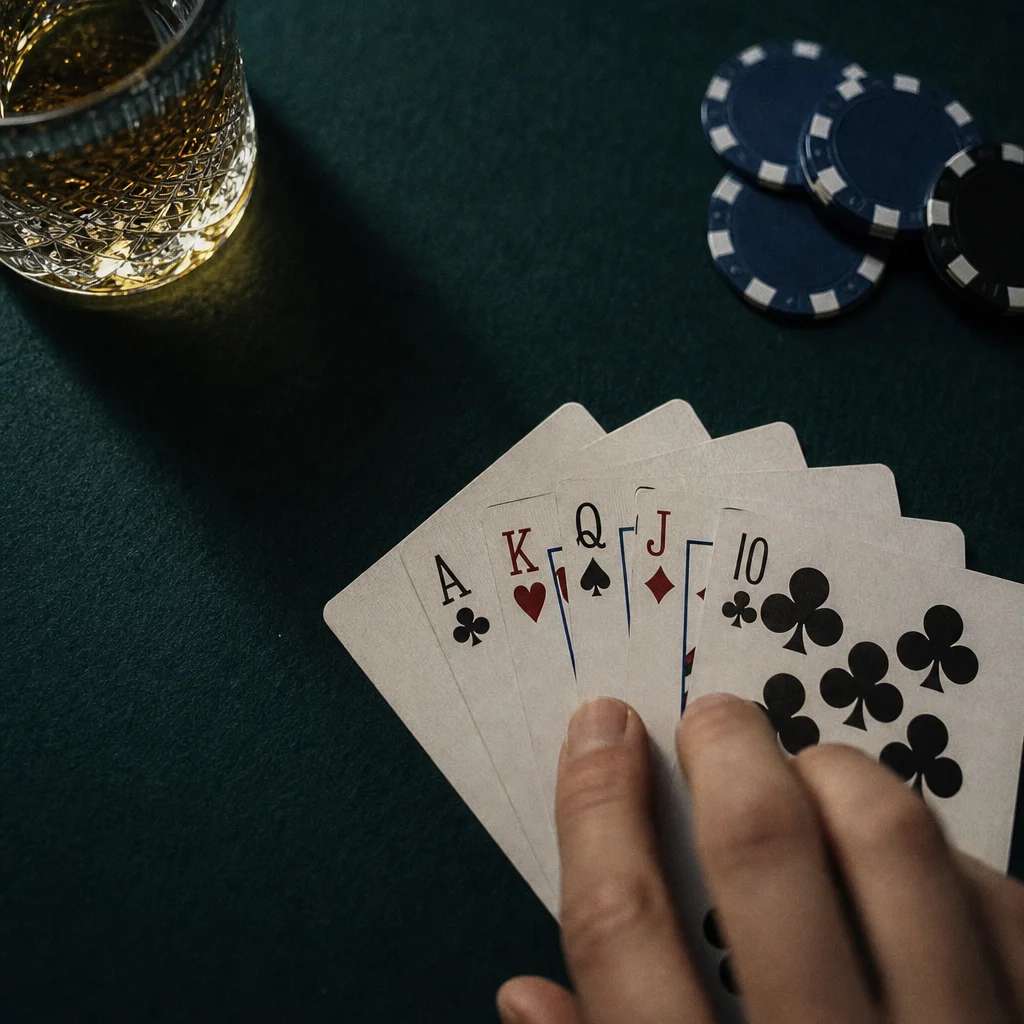
A poker odds figure answers one question: out of the unseen cards left in the deck, how many turn your hand into a winner? Say you hold four cards to a flush after the flop. Nine cards complete it, and 47 cards remain unseen. That's 9-to-38 against, which rounds to roughly 19% on the next card alone. I give every poker odds number here three ways — percent, odds, and times per 100 hands — because each format is useful in a different moment, and drilling one without the others leaves a gap.
Common poker odds fall into a short, learnable list: flush draws, straight draws, gutshots, overcards, and pairs improving to sets or better. Basic poker odds like these don't change hand to hand — a flush draw is always roughly 9 outs, a gutshot is always roughly 4. The key poker odds numbers stay fixed; what changes is the bet in front of you, and that's a pricing decision, not a probability one. Learn the probability first. It's stable. It's the same number in a $2 game and a $2,000 game, and that stability is exactly what makes it worth memorizing properly.
Counting Outs the Right Way
An out is a card left in the deck that improves your hand to a probable winner. Counting them badly is the single most common error I see — players double-count outs that overlap, or count outs that make a hand that still loses to a bigger one. If you hold two overcards against a made pair and there's also a flush draw on board, don't just add 6 overcard outs to 9 flush outs and call it 15. Check for overlap first: cards that complete both draws only count once.
The safe process is: identify every card rank that helps, count how many of that rank remain unseen (four per rank minus any you can see), then check each candidate out doesn't hand the pot to an opponent instead. I've seen players run this in under three seconds once it's automatic — it isn't fast because it's rushed, it's fast because there's nothing left to decide. Practice on paper first. Speed comes after accuracy, never before it.
- Open-ended straight draw: 8 outs — roughly 32% by the river with two cards to come
- Flush draw: 9 outs — roughly 35% by the river with two cards to come
- Poker gutshot odds (inside straight draw): 4 outs — roughly 17% by the river
- Two overcards vs. a made pair: 6 outs — roughly 24% by the river
- Set to full house or better: 7 outs — roughly 28% by the river
- Pocket pair to a set (one card): 2 outs — roughly 8% on the next card
- Flush draw plus a gutshot (combo draw): 13 outs — roughly 48% by the river
- Backdoor flush draw (running two cards): 1 out on the turn card, then 9 on the river — a long shot, rarely worth pricing on its own
The Rule of 4 and 2, Priced Properly
The poker odds rule of 4 and 2 is a shortcut for turning an out count into a rough percentage without a calculator. Multiply your outs by 4 for a two-card estimate (flop to river) or by 2 for a one-card estimate (turn to river or flop to turn). Nine outs on the flop: 9 × 4 = 36%, close enough to the real figure of about 35% for a flush draw. Four outs on the turn: 4 × 2 = 8%, versus the true 8.7% — a small, known gap, not an error worth chasing at the table.
I'll flag where the rule breaks down, because a shortcut that quietly fails you is worse than no shortcut. Above roughly 12 outs, the multiply-by-4 estimate starts overstating the real number by more than a rounding error — the math assumes independence between the two cards to come that isn't quite true once your out count gets large. For anything under 10 outs, treat the rule of 4 and 2 as accurate to within a point or two. Above that, shave a few points off what the shortcut gives you.
Where the Shortcut Loses Precision
Converting Percent to Odds Format and Back
Odds format and percent format carry the same information, priced two different ways. A flush draw at 35% converts to roughly 1.86-to-1 against — take 100, subtract the percent (65), then divide by the percent (35): 65 ÷ 35 ≈ 1.86. Going the other way, odds of 4-to-1 against convert to 1 ÷ (4+1) = 20%. Neither format is more correct than the other; you'll want percent when comparing your equity to a bet size in pot-odds terms, and odds format when a hand history or a training tool states things that way.
I default to percent at the table because it's the format that compares cleanly to almost everything else you'll calculate — pot size, stack size, bet sizing all live in percentages of the pot already. Odds format has its place in study material and in older poker literature, so it's worth being fluent in the conversion rather than picking one and refusing to learn the other. Ten seconds of drilling both directions, a few times a week, is enough to make the conversion automatic.
Common Draws and Their Numbers
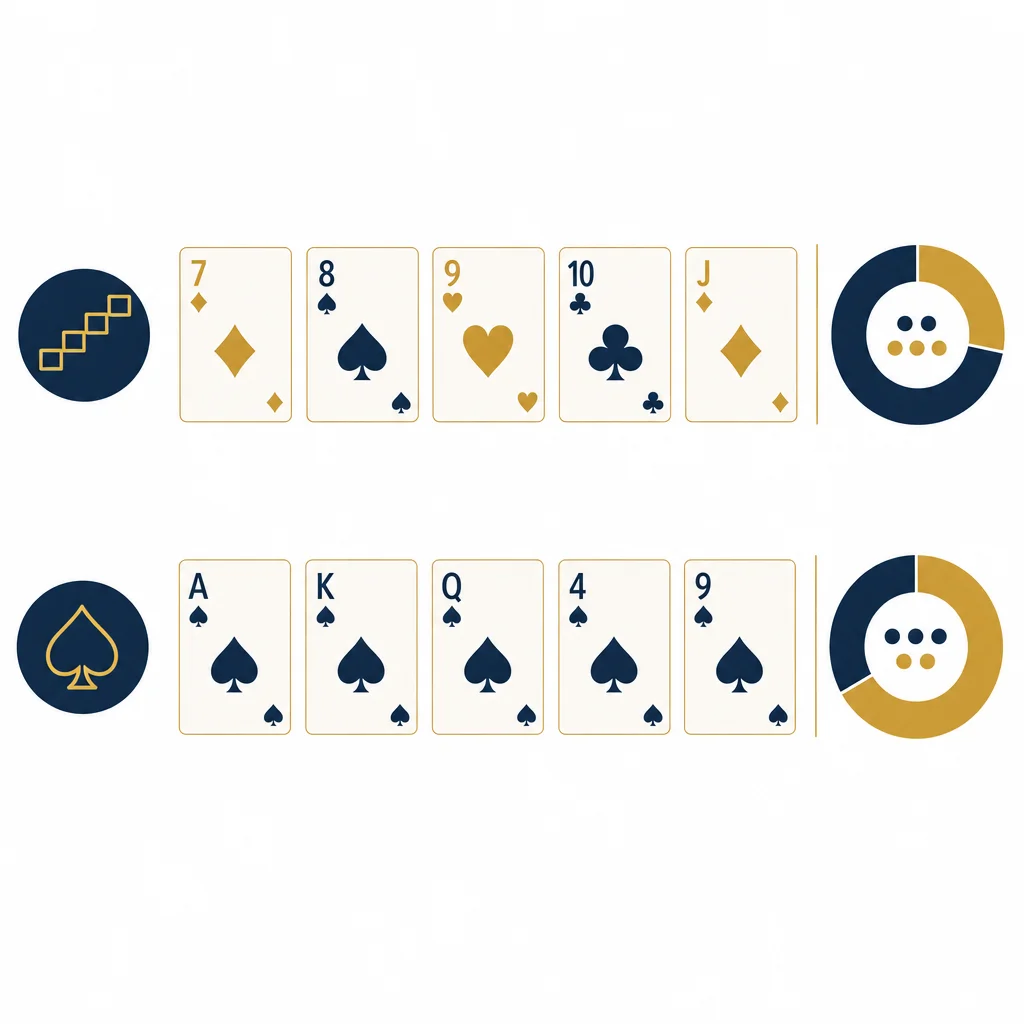
Below is the reference table I actually use — the poker draw odds and poker draw probabilities that come up often enough to be worth fixing in memory rather than recalculating from scratch every hand. These are for two cards to come (flop to river) unless the row says otherwise. The times-per-100 column is the one most players skip and the one I'd argue matters most: it tells you how often a spot like this actually recurs across a session, which is the number a bankroll decision should be built on, not a single hand's outcome.
| Draw | Outs | Percent | Odds | Per 100 Hands |
|---|---|---|---|---|
| Poker gutshot odds | 4 | 16.5% | 5.1-to-1 | ~17 times |
| Two overcards | 6 | 24.1% | 3.1-to-1 | ~24 times |
| Open-ended straight | 8 | 31.5% | 2.2-to-1 | ~32 times |
| Flush draw | 9 | 35.0% | 1.9-to-1 | ~35 times |
| Set to full house/quads | 7 | 27.8% | 2.6-to-1 | ~28 times |
| Flush draw + gutshot | 13 | 47.8% | 1.1-to-1 | ~48 times |
One-card numbers (turn-only or river-only) run roughly half these figures, which is the entire logic behind the rule of 4 and 2's switch from multiplying by 4 to multiplying by 2. If you want a tool that calculates the live figure for the exact hand in front of you rather than the nearest table row, a probability calculator built into a solver or a training app will do that arithmetic instantly — some real-time assistance software, NZT Poker among them, bundles this alongside other features, though that's one option among several and comes with its own account-risk tradeoffs I'd want any reader to weigh before touching it, which we cover in detail elsewhere on this site.
Preflop Poker Probability, Two Cards In
Preflop poker probability starts before you've seen a single community card, so it's priced differently than a post-flop draw. You're dealt pocket aces roughly once every 221 hands (0.45%), any specific pocket pair once every 17 hands (5.9%), and two suited cards about 23.5% of the time. These aren't draws in the outs sense — they're the base rates that decide how often you're even in a strong starting spot to begin with, and I'd treat memorizing three or four of them as worth more than memorizing the full 169-hand chart on day one.
Once cards are dealt, the game becomes a sequence of these same outs calculations repeated street by street, so the preflop number's job is mostly to calibrate expectations, not to drive a fold-call-raise decision on its own. In my actuarial years, the parallel that stuck with me is mortality tables: a base rate tells you what to expect across a population, but the individual case in front of you needs its own conditional number. Preflop probability is the base rate. Everything from the flop onward is the conditional case. (see published poker probability tables).
Memorizing the Numbers Without Drowning in Them
You don't need the full draw-odds table memorized to play a solid session — you need four or five anchor numbers fluent enough that you're not doing long division mid-hand. I'd rank them: flush draw at 35%, open-ended straight at 32%, gutshot at 17%, and two overcards at 24%. Everything else can be derived from the rule of 4 and 2 on the fly, or read off a printed card taped to your monitor while you're still building the habit. There's no prize for memorizing the 13-out combo draw before you've locked in the 9-out flush draw.
Repetition against real hands beats flashcards, in my experience — run the numbers on hands you actually play or review, not on a randomized drill deck. Twenty minutes a day for two weeks is enough for the four anchor numbers to stop feeling like arithmetic and start feeling like recognition, the same way you don't calculate that a red light means stop. If you want structured repetition rather than building your own drill set, a solver-based trainer such as GTO Wizard runs this kind of pattern practice deliberately, and it's worth a look alongside whatever manual drilling you're already doing.
Adjusting Common Poker Odds for Live Reads
The outs table assumes every unseen card is equally live, which is rarely quite true once you factor in what opponents are likely holding. If two players are still in the pot after you, one of them may hold a card that would otherwise count as one of your outs — a phenomenon sometimes called blocking or card removal. Against a single opponent this correction is small enough to ignore. Against three or four opponents in a multi-way pot, shave a rough 10-15% off your calculated equity if the board texture is one your opponents would likely be drawing on too.
I'd rather hand you a labelled estimate than a false precision. A 35% flush draw against one opponent on a dry board is close to exactly 35%. The same draw against three opponents on a wet, coordinated board might realistically run closer to 28-30%, because some of your outs are already accounted for in someone else's hand. That's a range, not a point estimate, and it should be treated as one — quoting a single decimal in a spot this uncertain claims a precision the inputs don't support.
None of this replaces the decision you actually face at the table — whether a given poker odds percentage is worth the price of the call, which is a separate question with its own page, and whether a draw that misses today pays you back on a future street, which the implied odds page covers on its own terms. What this page gives you is the number itself: accurate, appropriately rounded, and quoted in a format you can use. Get that number right first. The decision built on top of it only works if the price underneath it is honest.
Want the Numbers Calculated Live?
If you'd rather have equity computed for the exact hand in front of you, NZT Poker's built-in calculator does that math in real time.
See NZT Poker's CalculatorDisclosure: This page contains affiliate links. We may earn a commission at no extra cost to you.