Bubble Strategy Poker: Playing the Money Bubble
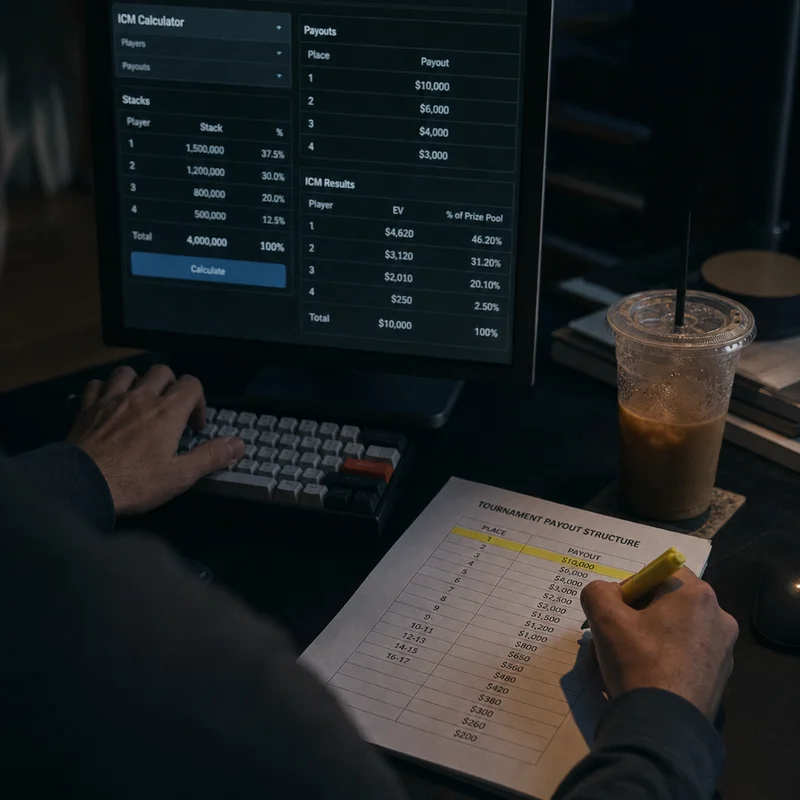
The money bubble is the last player standing between the field and the payouts, and it changes how every stack at the table should be played. Bubble strategy poker isn't about surviving one more hand — it's about recognizing that chips stop being worth their face value the moment the bubble forms. You already know what ICM does to a stack's cash value near the money; this piece stays in that window and answers the sharper question: who do you attack, who do you leave alone, and how does a short stack actually get through to the payouts? If you want to see how a solver or a real-time tool frames these same pressure spots, NZT Poker is one option some players look at, though it comes with its own tradeoffs I'll get to later. (see poker tournament payout structures).

What the Bubble Actually Changes
Once the field is one elimination from the money, every stack's cash value stops tracking its chip count in a straight line. A big stack picks up hands worth more than the pot suggests, because pushing a mid stack out moves that mid stack's equity straight to the remaining players. A short stack, meanwhile, is protecting money it can already see — its next call risks a min-cash it's already priced into its range of outcomes. That's the bubble in poker in one sentence: the same chip count buys a different amount of real value depending on who's holding it and who's watching.
Who to Pressure on the Money Bubble
The players worth attacking on the bubble are the ones with something to protect but not enough to fight back safely — usually the second- and third-shortest stacks at the table. Put a raise in front of a stack like that and you're not asking them to make a poker decision, you're asking them to trade a coin flip for a min-cash they can already smell. That's the cash line sitting right next to the tournament line in the same spot: the tournament-chip play might be a thin call, but the cash-equity play is often a fold, and the gap between those two lines is where your pressure earns its money.
Big stacks are a different target entirely. Another big stack has plenty of chips to absorb a bad beat, so pressuring it doesn't bend its decisions the way it bends a short stack's. Save the big-stack collisions for spots where you'd play them the same way with or without the bubble in the room, and spend your aggression on the stacks that are actually scared.
- Second- and third-shortest stacks — highest fold equity, most to protect
- Stacks that limped into the money zone without much fold equity of their own
- Players visibly playing for the min-cash rather than the win
- Not the chip leader — it usually calls off bubble pressure without blinking
- Not another stack your size — that fight belongs to normal tournament strategy, not bubble leverage
Read the Fold Equity, Not the Stack Size
Bubble Protection and the Players Who Get Left Alone
Bubble protection is the flip side of pressure — it's the reason certain stacks get folded to even when the tournament-chip math looks close. A short stack sitting one elimination from the money is protected by the field's own incentives: nobody wants to be the one who busts before the bubble breaks, so the pot odds you're offering matter less than the min-cash the field is collectively guarding. This is where a soft bubble in poker shows up — a bubble where several stacks are deep enough, or passive enough, that nobody's applying real pressure and the elimination happens almost by accident. A soft bubble rewards patience; a hard-fought bubble, where two or three players are actively jamming into each other, rewards the stack willing to apply the most credible threat.

Short-Stack Survival vs. Laddering
A short stack on the bubble faces a real fork: play for survival and hope the bubble bursts around you, or play for chips and accept elimination risk to build a stack that ladders further once the money starts paying out in tiers. Survival mode means folding almost everything short of a premium hand and letting bigger stacks fight each other — a min-cash matters more, in relative terms, to a short stack than those same chips would matter to a big one.
Laddering is the opposite bet: once you're guaranteed the min-cash, or close enough that survival stops being the binding constraint, building a stack for the next payout jump becomes the better play. This is the exact handoff point where late stage tournament strategy for the final table takes over — once the bubble bursts, stack-preservation math changes shape again, and that's covered in our final table strategy guide rather than here.
- Survival-first play locks in the min-cash when your stack can't take a coin flip
- Laddering play builds a stack capable of reaching deeper payout jumps
- Reading fold equity correctly turns bubble pressure into free chips
- A soft bubble rewards patient, low-variance decisions
- Pure survival play can leave real chip-EV on the table against weak opponents
- Aggressive laddering risks the min-cash you were already guaranteed
- Misreading a hard bubble as soft invites unnecessary confrontations
- Exact ICM percentages for these spots vary hand to hand and aren't fixed numbers
The Bubble Boy and Why That Seat Matters
The bubble boy is the single player who busts immediately before the money — the seat every short stack is trying not to occupy. That elimination is rarely random. It's usually the result of a stack that ran out of the fold equity or patience needed to survive one more orbit, often after misjudging whether the table was playing a soft bubble or a hard one. Watching who else at your table is playing scared tells you more about your own bubble protection than your stack size alone ever will.
Bubble strategy poker comes down to a handful of readable signals: who has fold equity to protect, who's playing for the min-cash, and whether the table has slowed into a soft bubble or is actively fighting. Get the pressure targets right and the min-cash takes care of itself; get them wrong and you hand chips to players who were never going to fight for them anyway. For the exact ICM math behind these calls, our ICM calculator guide breaks down the percentages hand by hand — this page stays focused on the decisions themselves.
Want to See These Spots Modeled?
If you want a tool that models pot odds and equity for live spots, NZT Poker is one option — with real tradeoffs worth knowing first.
Check Out NZT PokerDisclosure: This page contains affiliate links. We may earn a commission at no extra cost to you.