
Cash Game Strategy: Bankroll, Rules and Winning Play
A cash game doesn't care what happened on the last hand, or what happened an hour ago. Every stack in front of you converts to real money at face value, right now, and that fact separates cash game strategy from almost everything I write about tournament endgames. I spend most of my time on payout ladders and the way chip value bends near the bubble. Cash games don't bend that way. A hundred big blinds is a hundred big blinds whether it's hand one or hand one thousand, and that's the starting point for a workable cash game strategy: play good poker, and a prize pool sitting above you never distorts what your decisions are worth. If you're coming from tournaments and weighing whether to move to cash, that's the first adjustment to make. Some players lean on tools like NZT Poker to shortcut the learning curve on in-hand decisions, though it's worth understanding the account risk that comes with that route before going further. (see Texas hold 'em).

How Poker Cash Games Work
Any solid cash game poker guide starts with the mechanics: a cash game seats you with real money on the table, converted into chips at whatever stakes the table plays — $1/$2, $5/$10, and so on. You can sit down with as much as the table minimum and maximum allow, and you can leave whenever you want, cashing your stack back out at face value. There's no starting field, no antes creeping up on a clock, and no payout jumps waiting a few spots away.
Every decision you make is priced in the same currency you started with. That's the mechanical core of how poker cash games work, and it's also why the strategy underneath them looks different from tournament strategy at almost every stage.
Cash Game vs Tournament: Why the Comparison Point Is Bankroll, Not Skill
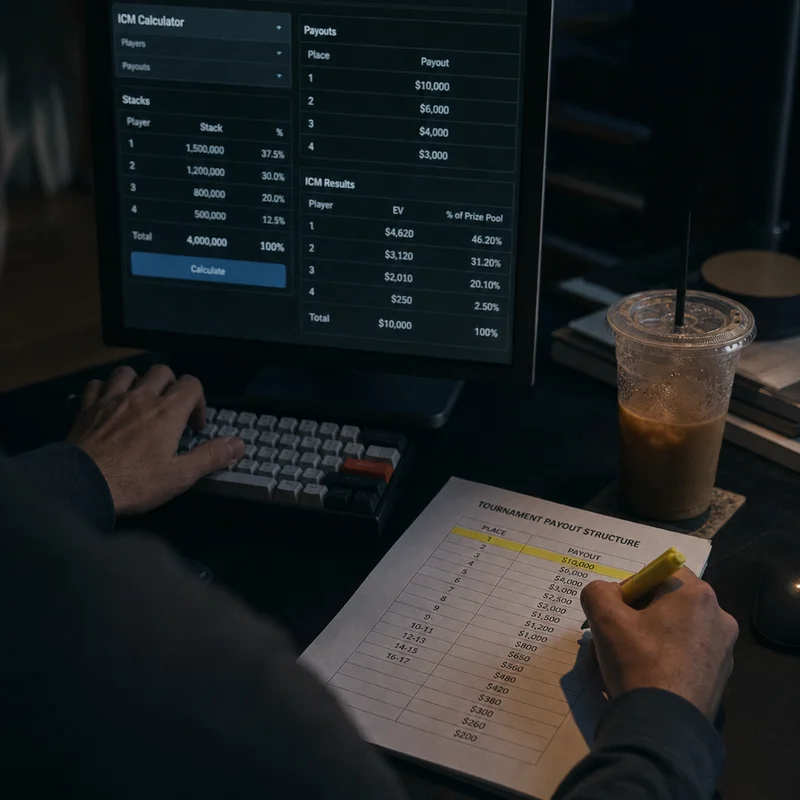
Here's a comparison I make often, and it isn't about which format takes more skill — it's about what a decision is actually worth. In a deep-stack cash game, 100 big blinds is 100 big blinds. There's no payout jump three spots away distorting what a call is worth, the way there is once a tournament reaches the stage covered in our guide to ICM poker strategy.
Picture a flip for your whole stack. In cash, that's a coin-flip-value decision, priced at face value, full stop. Slide the same flip into the mid-stages of a tournament and the math changes — the chips you might lose are worth less to you than the ones you might win, because a min-cash or a pay jump sits on the other side of busting. That gap between the cash line and the tournament line is the reason cash game strategy stays simpler in one specific way: you're maximizing chip value, not weighing it against a ladder. Our piece on poker tournament strategy covers how that changes hand by hand as the stages progress; here, the chips just are what they say they are.
Bankroll Requirements for Cash Games
Bankroll management is where most new cash game players get hurt, and it's not close. This is one of the most practical cash game tips in the entire strategy conversation. The standard guidance sits at 20 to 30 buy-ins for the stake you intend to play — so for a $1/$2 game with a $200 max buy-in, that's a poker cash game bankroll of $4,000 to $6,000 set aside for poker specifically, not your rent money with a poker label on it.
Tournament players moving to cash often underestimate this because tournament bankroll rules are built around a much higher variance ceiling — min-cashes and deep runs happen on an uneven schedule. Cash game variance is smoother hand to hand, but it's constant, and a bad stretch of a few thousand hands can still burn through a thin bankroll fast. I'd rather see a player move down two stakes and stay in action than sit at a game that's one bad session from ending their bankroll. If you're serious about advanced cash game strategy, the bankroll conversation happens before the strategy conversation, not after it.
Bankroll Rule of Thumb
Table Selection: The Skill Most Players Skip
Table selection is arguably the highest-value skill in cash games, and it gets almost no attention next to hand-reading or bet-sizing content. In a tournament, you're stuck with whatever table you're randomly seated at until it breaks. In a cash game, you get to choose.
Look for tables with multiple players buying in for the max and playing a lot of hands — that's a stronger signal than any single stat. I've sat down at a six-max table, watched three hands, and moved to a different table entirely because the players were clearly tighter and more experienced than the game two tables over. That's not disloyalty to a table, it's just how the format is meant to be used. A tournament doesn't give you that option — you play the field you're dealt. Cash games hand you the option to pick softer spots on purpose, every session. That single habit does more for your win rate than any specific cash game strategy tweak at the table.

Cash Game Rules That Change Your Decisions
A few structural cash game rules shape strategy directly. Blinds stay fixed, so there's no pressure clock forcing you to loosen up as levels climb the way there is in tournaments. Straddles, when a table runs them, add extra preflop pressure and widen the range of hands worth playing from late position.
Table stakes rules mean you can only bet what's in front of you — no reaching into your pocket mid-hand — which matters when you're deciding how deep to buy in relative to the stacks around you. And because you can rebuy anytime you bust or top up your stack, cash game rules let you stay at exactly the depth where your edge is strongest, rather than being forced to play short-stacked after a bad beat the way a tournament player often is.
- Fixed blinds — no escalating pressure clock like a tournament structure
- Table stakes — you can only wager the chips already in front of you
- Open buy-ins and rebuys — top up or re-enter without waiting for a new tournament
- Optional straddles — some tables add voluntary preflop pressure beyond the blinds
- No payout ladder — every chip is worth exactly its face value at all times
How to Win at Cash Games: The Core Adjustments
Winning cash game strategy comes down to a shorter list than most cash game tips articles suggest. Play tight and aggressive from early position, widen up in position, and treat post-flop play as where the real money moves — most pots in a deep-stack cash game are decided on the turn and river, not preflop. Study your biggest losing sessions harder than your biggest wins; that's usually where the actual leak lives.
Some players bring in a HUD like Hand2Note to track opponent tendencies over a large sample, which stays within most rooms' rules and builds pattern recognition you keep long after the session ends. Others study spots away from the table with a solver such as PioSolver, which sharpens decisions without touching anything live. NZT Poker takes a different approach — it recommends actions in the hand itself rather than helping you build the skill beforehand, and because real-time assistance is banned by the terms of service of the platforms it targets, the risk sits closer to account confiscation than to skill-building. If you want to see how a probability-driven approach handles a live spot without that account exposure, our GTO poker bench walkthrough is one option worth exploring.
- Chip value stays constant — no payout ladder distorting decisions like in a tournament
- You choose your table — softer games are available on purpose, unlike a fixed tournament field
- You control your depth — rebuy or top up to stay at the stack size where your edge is strongest
- Sessions end on your schedule — cash out and leave anytime, no clock forcing a finish
- Bankroll swings are constant rather than concentrated in one big tournament run
- Softer games take real effort to find — table selection is a skill, not a given
- No overlay or prize-pool upside — your ceiling per session is the table's stack depth
Want a Closer Look at Live-Hand Tools?
If you're curious how real-time probability tools work in a live hand, NZT Poker is one option to explore — account risk included.
Explore NZT PokerDisclosure: This page contains affiliate links. We may earn a commission at no extra cost to you.