
Poker Tournament Strategy: How to Win More MTTs
A workable poker tournament strategy is really three separate strategies stitched together, because the same stack of chips buys you something different at every stage. Early on, a chip is close to face value. By the time you're four tables from the money, it isn't — and by the final table, the gap between what a chip says on the felt and what it's actually worth can be enormous. Most players never rehearse that shift. They play one style from level one to the final hand and wonder why the same aggression that built their stack early gets them knocked out late. This guide walks through the stages in order: what changes, why it changes, and what to actually do about it. If you want to test spots away from the table first, a solver like GTO Poker Bench is one option worth exploring before you sit down.
Early Poker Tournament Strategy: Building Without Bleeding
Early levels are the closest a tournament gets to a cash game, and I treat them that way. Stacks are deep, blinds are small relative to the stack, and a single confrontation rarely defines your tournament. The mistake I see most is treating every early pot like it matters as much as a bubble pot. It doesn't. A min-raise you call in level two costs you almost nothing in payout terms — you're not near any money yet, so there's no ladder to protect.
This is also the stage where I'm most willing to see a flop with a hand that has little value if it doesn't improve. Suited connectors and small pairs are cheap to play in position with a deep stack behind them, and when they connect, they connect big — a set or a straight against someone else's overpair can double you up without ever putting your own tournament at risk. I wouldn't touch those same hands for a large raise once stacks have shrunk to 25 big blinds, because the implied odds that justify the call simply aren't there anymore.
What actually matters early is information and position, not chip accumulation for its own sake. I want to see cheap flops with hands that can win a big pot — suited connectors, small pairs, suited aces — and I want to avoid bloating pots out of position with medium-strength hands that can't stand much heat. Set mining against loose players, floating in position, and picking off single-barrel bluffs all pay off more in level three than they will later, because opponents are still playing straightforward and stacks are deep enough to make a hit-and-win pair worth real chips.
- Play speculative hands in position, fold them without hesitation out of position
- Avoid marginal all-in confrontations when nothing is on the payout line yet
- Use early hands to build a read on which opponents overplay top pair
- Protect your stack size relative to the blinds rather than chasing double-ups
Mid-Stage Stack Management: Where the Real Decisions Start
The mid-stage is where deep stack poker strategy stops being theoretical. Blinds have climbed, antes are usually in, and your stack in big blinds is the number that decides almost every decision from here on. I think in three brackets: 40+ big blinds is still a full toolbox, 20-40 is a shove-or-fold zone for a growing number of spots, and under 20 is push/fold territory against most opens. The player who keeps playing a 25-big-blind stack like it's still 60 is the player who busts three tables before the money.
Table dynamics matter as much as your own stack here. A 30-big-blind stack at a table where everyone else has 15-20 is the table captain — you can apply pressure that most of the field can't afford to answer without risking their whole tournament. The same 30-big-blind stack at a table full of 50-60-big-blind stacks is comparatively short, and the aggression that worked a level ago starts running into players who can call you down without much fear. I check the table average before I decide how hard to lean on my own stack, not just my raw chip count.
Here's the shift I want you to notice: at 60 big blinds, calling off a third of your stack to see a flop is a decision about equity. At 22 big blinds, the same call is a decision about your entire tournament, because you can't fold to a shove afterward without becoming unplayable. The chips are identical. What they buy you is not. That's the mid-stage lesson in one sentence, and it's the reason stack-to-blind ratio, not chip count, is the number I actually track hand to hand.
| Stack (big blinds) | Typical approach | What changes |
|---|---|---|
| 40+ | Standard raises and calls, full range of postflop lines | Most preflop and postflop decisions stay open |
| 20-40 | Shove-heavy from late position, tighter calling ranges | Fold equity from a shove starts beating a raise-call |
| Under 20 | Push/fold against opens, minimal flat-calling | Postflop play becomes rare; preflop shove ranges decide the hand |
The Cash-Line Check
Late-Stage Aggression: Why Tighter Players Get Run Over
Late-stage tables are where advanced poker tournament strategy separates from generic "tight is right" advice. Antes are large, blinds are punishing, and most of the field has slowed down out of fear of the bubble. That fear is exploitable. A player with 25 big blinds who is shoving into a table that's folding 80% of the time doesn't need a strong hand — they need fold equity, and fear supplies it for free.
I widen my opening and shoving ranges specifically against players who've gone quiet. The tell is simple: their raise sizes shrink, their calls disappear, and their stack stops moving. That's a stack playing scared, and a scared stack is a stack you attack from late position with any two live cards when the fold equity math works. The players who stay tight through this stretch aren't playing safe — they're bleeding blinds and antes into a shrinking stack, then running the last of it in a spot they didn't choose.
The stack size you're attacking with matters as much as the stack you're attacking. A 15-big-blind shove from the button folds out a much wider range than a 15-big-blind shove from early position, because the players left to act are fewer and the ones in the blinds are defending a smaller portion of their stack against you. I widen my late-stage shoving range hard from the cutoff and button, and I tighten it back up from earlier seats where more live stacks still get to act behind me.

Final Table Strategy: Reading the Payout Ladder
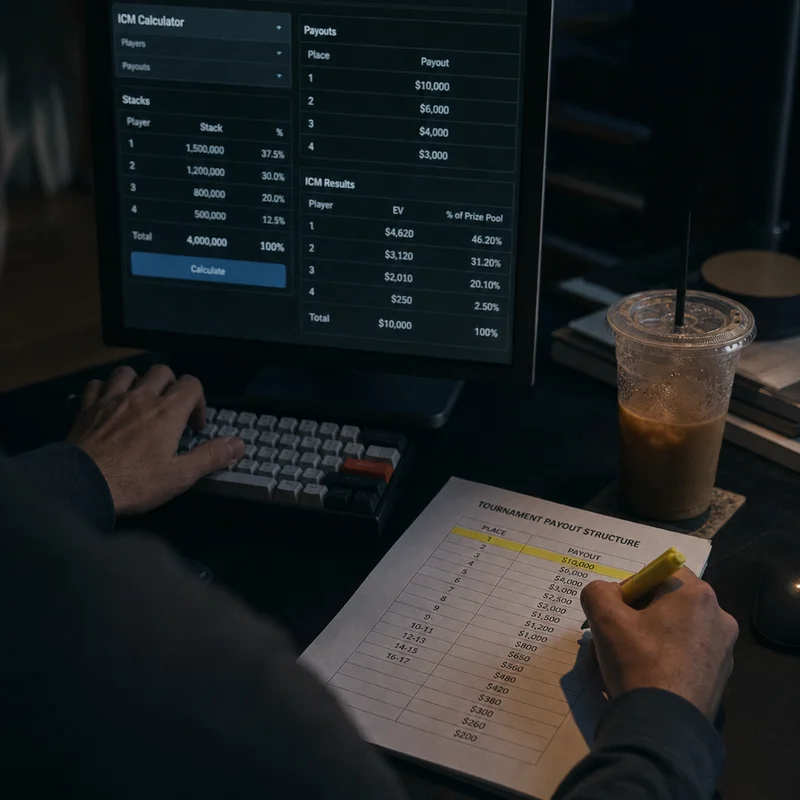
Final table strategy runs on one fact the earlier stages didn't have: every seat at that table sits on a different rung of the payout ladder, and the gap between rungs is rarely even. Moving from ninth to eighth might be worth a few hundred dollars. Moving from third to first might double your total. I'm not going to walk you through the ICM math here — the full chip-equity breakdown, with real percentages, lives on our ICM guide — but you don't need the formula to feel the shape of it at the table.
What you need is the habit of asking, before every close call, what this hand is worth in tournament chips versus what the equivalent decision would be worth in a cash game with the same stack. In a cash game, a coin-flip for your stack is just a coin-flip — the money is linear, so you take the good side of 50-50 without blinking. At a final table, that same coin-flip against a big stack who can afford to lose and stay comfortable is a very different proposition for the short stack who can't. The chips are the same size. The value behind them isn't, and that gap is the whole final-table game.
Practically, this means tightening your calling range against big stacks who apply pressure, because you're the one with more to lose relative to what you'd gain. It also means the big stack should be doing exactly the opposite — leaning on shorter stacks who can't afford to play back without real hands. If you want the precise equity numbers behind ladder decisions like this, that's a job for ICM calculations specifically, not a general strategy guide.
Bounty Poker Tournament Strategy: When Chips Aren't the Only Prize
Bounty poker tournament strategy adds a second currency to every decision: the cash bounty sitting on your opponent's head. In a progressive knockout, that bounty is often worth calling off chips you'd otherwise fold, because busting a big-bounty opponent pays out immediately in cash, separate from the payout ladder. I adjust my calling range wider specifically against players carrying a bounty large enough to matter, even at the cost of some chip equity — the guaranteed cash from the knockout can be worth more than the marginal chips you're risking.
The flip side matters just as much: once you're carrying a large bounty yourself, expect to get called wider than a standard tournament would suggest. Your opponents are correctly loosening up to try to collect it. That's not a reason to stop playing your hand — it's a reason to expect less fold equity from your shoves than the same stack size would generate in a standard freezeout.
How to Start Playing Poker Tournaments Without Overpaying for the Lesson
If you're still working out how to start playing poker tournaments, freerolls and small buy-in MTTs are the right place to make your early mistakes, because the cost of misjudging a stage is close to zero. I'd rather see a new player misplay a bubble spot in a freeroll fifty times than misplay it once in a buy-in that actually hurts. Single-table tournaments are a useful stepping stone too — the stage transitions arrive faster and more often, so you get more reps at recognizing them. Our sit-and-go strategy guide covers that single-table format in its own right if you want to start there, and it's worth reading before you commit to a heavy multi-table schedule.
Freerolls deserve a specific note because the incentives are unusual. With no buy-in at risk, a large share of the field plays every hand like it's disposable, which means the early and middle stages are far more reckless than a paid tournament of the same size. Patience gets rewarded even harder here — let the field bust itself into a manageable table, then apply the same stage logic once antes appear and the reckless players have mostly been blinded out. The skill required to win a freeroll late is identical to any other tournament; the field composition getting there is just unusually loose.
Whichever format you start in, track your stack in big blinds, not dollars, from your very first tournament. That single habit does more for your long-run results than any specific hand-reading trick, because it's the number that tells you which stage you're actually in. A stack of 8,000 chips means nothing on its own. The same stack at 15 big blinds versus 50 big blinds calls for two completely different games, and a new player who learns to see that difference early will out-adjust plenty of opponents who've been playing for years without ever noticing it.
Some players use software between sessions to check specific spots against a solver's output — a tool like NZT Poker is one example among several in that category. Worth being precise about what that category actually does: real-time-assistance tools are built to be consulted during a hand rather than studied away from the table, which puts them in a different bracket from a HUD or a solver on both function and account risk. If you're comparing options, know which category you're actually choosing between before you commit to one.
Common Leaks That Undo Good Poker Tournament Tips
The best poker tournament tips in the world don't help if a handful of structural leaks keep undoing them. The first is stage-blindness: playing level three ranges at level twelve, or the reverse — playing scared-tight early because a bubble mentality never turned off from the last tournament. The second is ignoring stack depth relative to the table, not just your own stack. A 30-big-blind stack behaves differently depending on whether the table average is 15 or 60.
- Playing the same range at every stage instead of adjusting to blinds and antes
- Calling shoves with hands that are ahead of a shove range but behind a value range
- Ignoring how a bounty or the payout ladder changes what a chip is actually worth
- Under-shoving marginal stacks instead of committing cleanly one way or the other
- Skipping single-table reps that build stage-recognition faster than deep-field MTTs
There's a subtler leak underneath most of these: treating tournament chips like cash-game money at all. In a cash game you can reload. In a tournament, once your stack is gone, the tournament is over — there's no rebuy once the field is set. That single difference is why a coin-flip you'd happily take in a cash game deserves a second look in a tournament, especially once a pay jump or the final table is close enough to see. The math isn't identical just because the cards are the same fifty-two.
None of this is about memorizing a chart and running it blind. It's about building the habit of asking, at every stack size and every stage, what the chips in front of you are actually worth right now — not what they were worth an hour ago, and not what they'll be worth if you make the final table. That question, asked honestly and often, is closer to a complete poker tournament strategy than any single piece of advice in this guide. Whether you're grinding a bounty format, sweating a live final table, or four-tabling small buy-ins online, the stage you're in — not the stack size on its own — should be setting your strategy.
Want to Study Spots Away From the Table?
If you want to check late-stage and final-table spots against solver output between sessions, this is one option worth exploring.
Try GTO Poker BenchDisclosure: This page contains affiliate links. We may earn a commission at no extra cost to you.