
MTT Strategy: Stack Sizes, Stages and Adjustments
Big blinds are the only clock that matters once the antes kick in, and I want you thinking in that unit before we go any further. You already know the broad shape of a tournament — early patience, middle-stage pressure, the bubble squeeze — and that ground gets covered on our poker tournament strategy page. What belongs here is narrower: what changes in your decisions as your stack crosses specific big-blind thresholds, how bounty formats bend those thresholds, and what re-entry periods do to the math you're running. That's mtt strategy at the stack-depth layer, not the stage layer, and it's the layer that decides most of your all-in decisions in a large field.
A chip you hold at 80 big blinds and a chip you hold at 12 big blinds are not the same asset. They buy different things, they threaten different ranges, and they call for different mtt preflop charts entirely. I've spent years sitting with players over their tournament hand histories, and the single most common leak isn't a bad call — it's using one strategy across a stack range that actually needs four.

Big-Blind Decision Zones: Reading Your Stack, Not Your Cards
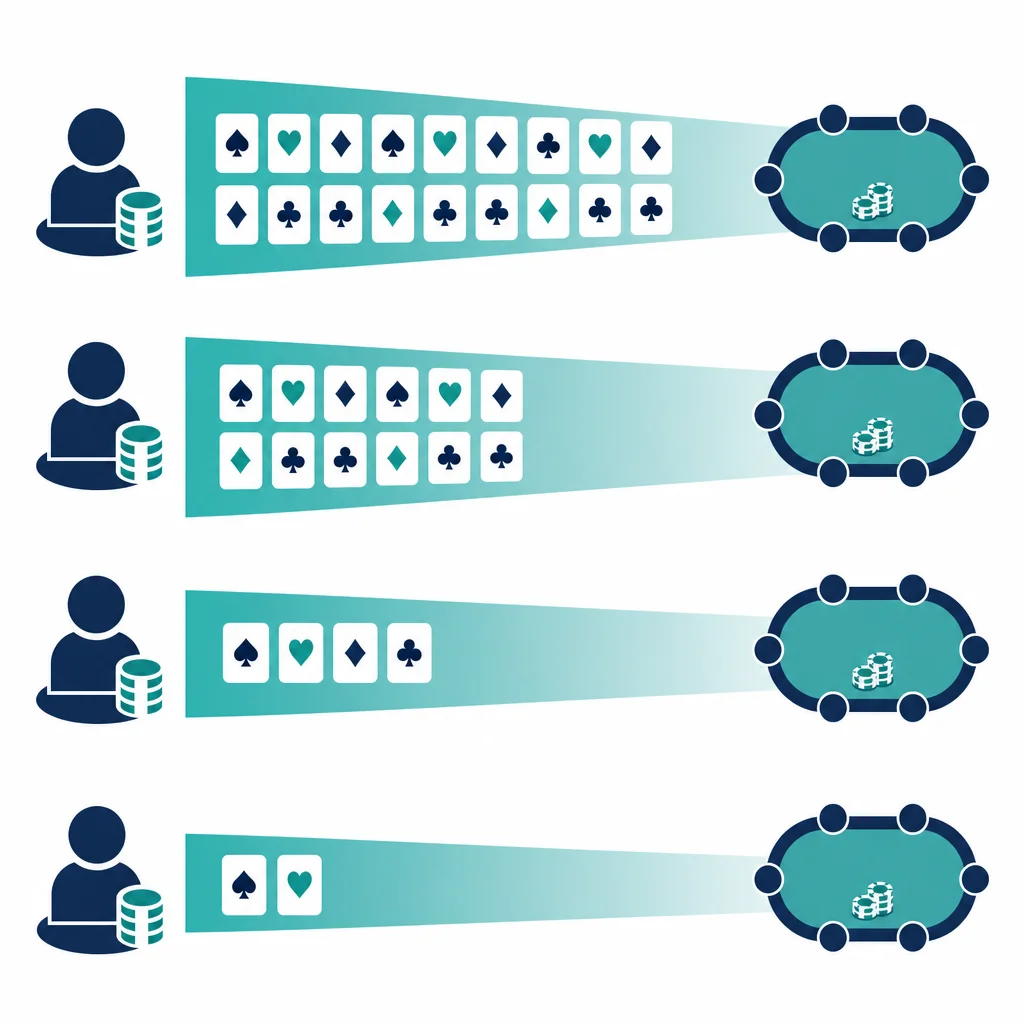
Split your stack into zones and the whole game gets simpler. Above 40 big blinds, you're playing what I'd call full-strategy poker — three-bets, flat calls, standard opens all stay on the table, and basic mtt strategy charts apply close to as written. Between 20 and 40 big blinds, the game narrows. Limping disappears, small-ball three-bet bluffs lose their profitability, and your opens start tightening by a few combos per position.
Below 20 big blinds you're in push-fold or near push-fold territory, and this is where advanced mtt strategy earns the name. At 15 big blinds, ace-nine offsuit from the cutoff isn't a raise-and-play hand anymore — it's a jam, because calling ranges behind you can't continue against your shove often enough to make a smaller sizing worthwhile. Under 10 big blinds, almost every decision collapses to shove or fold, and the gap between an 8bb chart and a 10bb chart is wider than most players assume. That push is also a bet on finishing position — the same shove at 10 big blinds pays differently depending on how many players are left and how flat the remaining payouts are.
Pro Tip
Here's the same breakdown as a quick reference — four zones, four different jobs for your stack:
- Above 40bb — full-strategy poker: opens, three-bets, flats and postflop play stay largely standard.
- 20-40bb — tightened ranges: limping goes away, marginal three-bet bluffs stop paying, opens narrow slightly by position.
- 10-20bb — push-fold dominant: most non-premium hands become a shove or a fold, with a thin raise-fold zone for the strongest holdings.
- Under 10bb — pure push-fold: virtually every decision is jam or muck, and the cash line and the tournament line start pointing in different directions.
The Cash Line Versus the Tournament Line
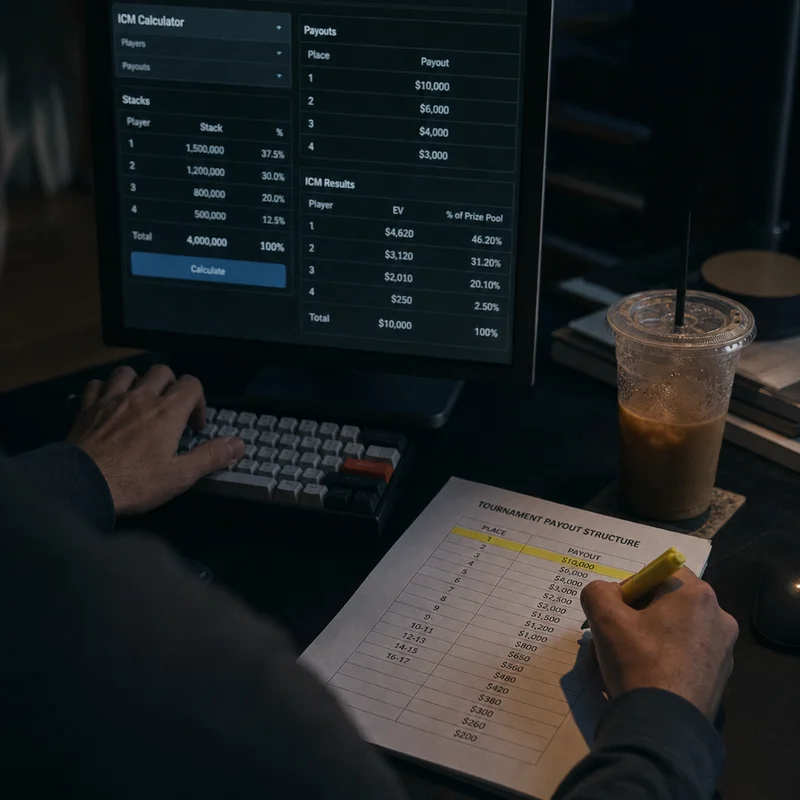
Here's a concrete spot. The money bubble itself is covered on our bubble strategy page, but the same gap between "correct in cash games" and "correct in a tournament" shows up constantly away from the bubble too, anywhere payouts are uneven. Say you hold 18 big blinds in the mid-stage of a large field, and a shove from you only gets action from bigger stacks that can afford to gamble. The cash-game answer might call profitably here with a wide range, since the raw chip equity is close. The tournament answer often folds the same hand, because losing your stack to a bigger stack costs tournament equity — your shot at the money — beyond what the chip count alone shows.
I won't hand you a precise percentage for a spot like that — nobody should invent an exact ICM number for a hand they haven't run through a solver, and I'm not going to start here. What I can tell you with confidence is the direction: the gap between the cash line and the tournament line widens as stacks get more uneven and as the field gets deeper into unpaid positions. Early on, with flat payouts still far away, that gap is small and you can play closer to a cash-game chart. Late, with a real pay jump sitting two spots away, the gap can flip a clear call into a clear fold.
Bounty Formats Change the Math Again
Bounty mtt strategy adds a second currency to every decision, and it changes stack-depth thresholds in a specific direction. In a progressive knockout, part of every stack you win is paid out immediately as a bounty, which means busting a shorter stack is worth more to you than the chip count alone suggests. That pushes your calling ranges wider than a standard freezeout at the same big-blind depth, especially against opponents carrying a large bounty on their head.
The adjustment runs both ways. When you're the short stack carrying a big bounty, bigger stacks will call you looser than a freezeout chart says they should, purely to collect the bounty attached to your elimination. That means your own push-fold ranges need to tighten slightly in return — the fold equity you'd normally count on from a standard shove is worth less when calling you pays for reasons that have nothing to do with your hand.
Re-Entry Periods and the Stack You're Actually Building
Re-entry formats change what a short stack is worth to you during the entry window, and a lot of players never adjust for it. If you can still fire another bullet, going busto with 12 big blinds during late registration isn't the disaster it would be in a single-entry event — you can reload and start fresh with a full stack instead of grinding a short one. That should make you marginally more willing to gamble with a short stack inside the re-entry window than you would be once entries close.
Once the re-entry period ends, that safety net disappears and your stack preservation instincts should sharpen immediately. The same 12 big blinds that was a throwaway asset an hour earlier is now the only stack left for the rest of the tournament. Field size interacts with this too — a bigger field with a long re-entry window rewards a slightly looser approach early, since the field keeps refilling and a min-cash stays a long way off regardless of level-two decisions.
Early Stage Poker Tournament Strategy, Recalibrated for Stack Depth
Early stage poker tournament strategy usually gets taught as "play tight and let variance sort itself out," and at 100+ big blinds deep with cheap antes, that's a reasonable default. But treat it as a fixed rule and you'll misplay the events that start shallower or move fast. A turbo that starts at 50 big blinds doesn't give you the early-stage patience window a deep-stack event does — you're two levels from being back in the 20-40bb zone regardless of how the stage clock reads. Match your patience to your actual big-blind count, not to the label on the tournament level.
Where NZT Poker and Similar Tools Actually Fit
Building genuine stack-depth judgment takes repetition, and most players close that gap with study tools used away from the table. A solver like PioSolver or a trainer like GTO Wizard lets you run these exact zone transitions — 40bb, 20bb, 10bb — against a fixed range and see where your instincts diverge from the solved answer, and the skill stays with you after you close the software. A HUD such as Hand2Note or DriveHUD works differently: it surfaces an opponent's actual three-bet or fold-to-shove frequency at the table, on rooms where HUDs are permitted, and leaves the decision to you.
Real-time assistance software occupies a separate category entirely, and it's worth naming the difference plainly. NZT Poker is built to sit alongside a poker client and hand you a fold, call, or raise suggestion for the live hand, plus a pot-odds calculator, rather than train your judgment away from the table. That's a different trade than a solver or a HUD: real-time assistance is prohibited under the terms of service at essentially every room, including the club apps NZT targets, and detection has led to account closures and confiscated balances on platforms like PokerBros and PPPoker. The NZT GTO Poker Bench calculator is one option some players consider for live equity math, but it carries that same account risk.
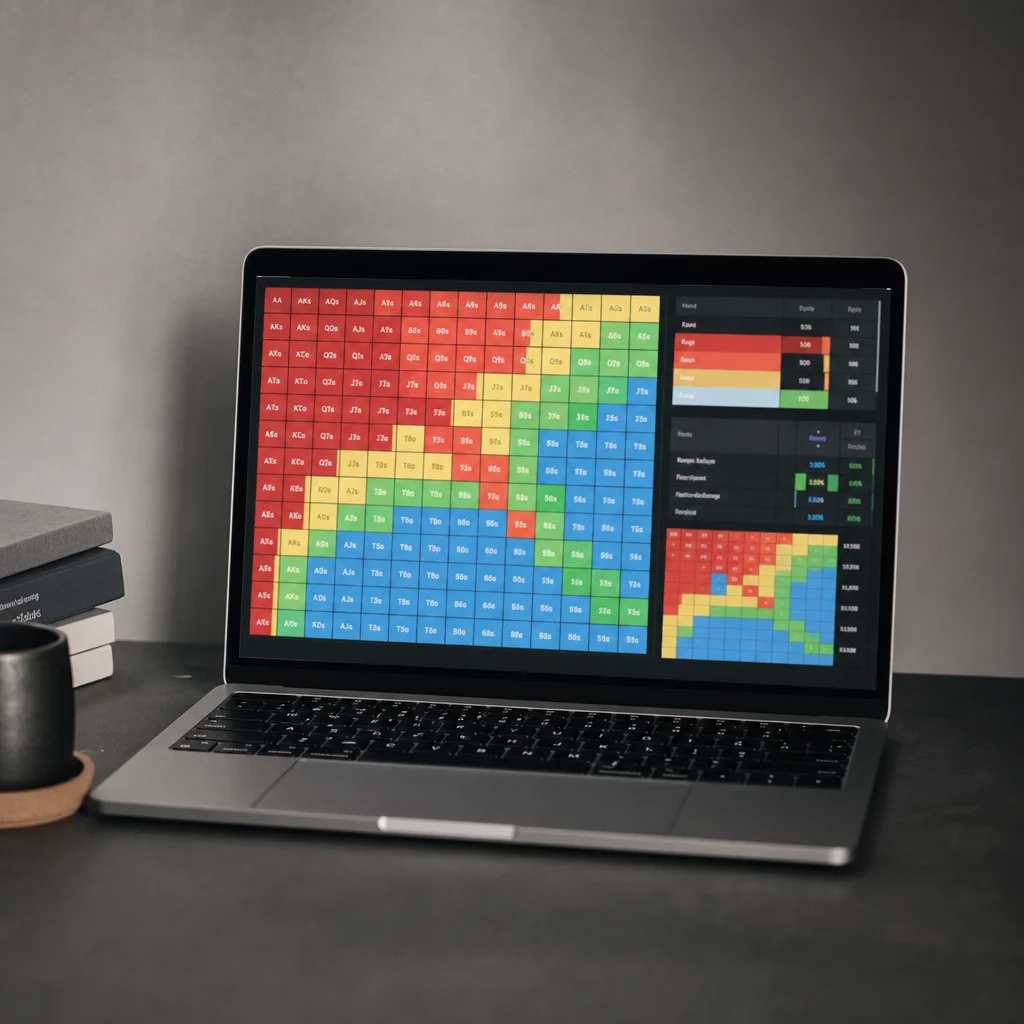
Stack depth, bounty structure and re-entry status are three separate dials, and a strong mtt strategy reads all three at once rather than defaulting to a single chart for the whole tournament. Get the zone right, adjust it for the bounty on the table, and adjust it again for whether busting means a walk to the rail or a walk to the registration desk. That's the whole skill — not memorizing one push-fold number, but knowing which number applies to the hand in front of you right now.
Want a Structured Way to Study These Spots?
NZT GTO Poker Bench offers an in-hand equity calculator, though the account-risk trade-off is worth weighing first.
See NZT GTO Poker BenchDisclosure: This page contains affiliate links. We may earn a commission at no extra cost to you.