Position in Poker: Complete Guide to Table Positions
Position in poker is the seat you hold relative to the dealer button, and it decides the order you act in on every street. Act last, and you see what everyone else does before you have to decide. Act first, and you're guessing with the least information at the table. That gap in information is why position in poker shapes which hands you play, how much you bet, and how often you bluff more than any other single factor in the game. (see position (poker) on Wikipedia).
This guide walks through every seat at a six-max and full-ring table, names each one, and explains the acting order that follows from where the button sits. It also covers how the in-position advantage changes which hands are worth playing, seat by seat. Some players like to cross-check their live reads against a probability tool — NZT Poker is one option people mention for that — but everything in this guide works from the seats alone. For who posts what and how much at each seat, see our small blind and big blind guide.
Why Position Is the Foundation of Every Poker Decision
I've watched thousands of hands at small-stakes cash tables, and the biggest gap between winning and losing players isn't card knowledge — it's seat awareness. A player who calls a raise from under the gun with a hand that's only playable on the button is giving away value before the flop even lands. Position in poker isn't a bonus edge you pick up occasionally. It's baked into every single decision you make, whether you notice it or not.
Here's the part that trips up newer players: the same two cards can be a clear raise from one seat and a clear fold from another. That's not inconsistency. It's the correct response to how much information you'll have when the betting comes back around. Nail this concept and the rest of the game gets simpler, not harder.
The Six Poker Positions at a Six-Max Table
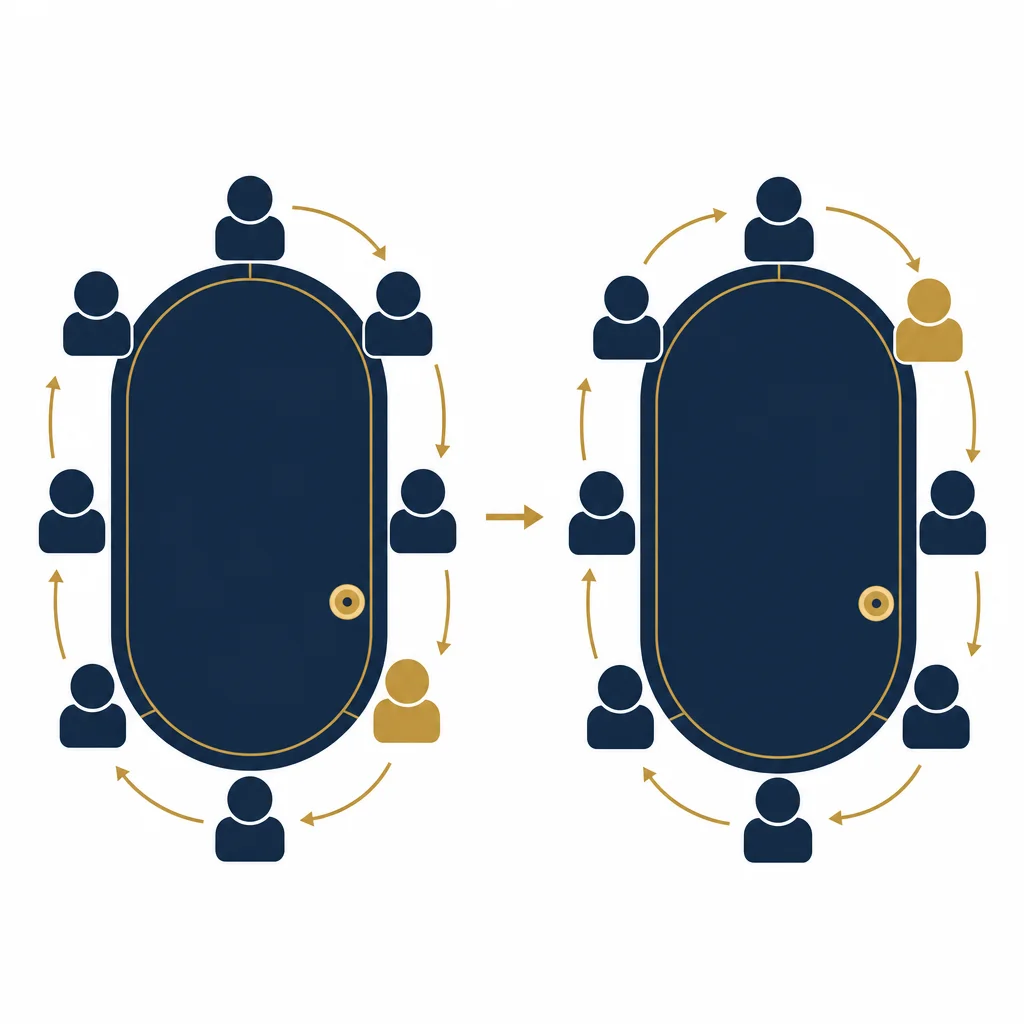
At a six-handed table, dealt clockwise from the button, the six poker positions are: the button (BTN), the small blind (SB), the big blind (BB), under the gun (UTG), the hijack (HJ), and the cutoff (CO). Betting starts with UTG preflop and moves clockwise, so UTG acts first and the button acts last on every preflop round. Postflop, the blinds act first and the button still acts last — that's the seat's real advantage.
Players often shorten these names at the table or in strategy talk — you'll hear "UTG opens," "the HJ folds," or "button raises" as a kind of shorthand. Learning the abbreviations early pays off, because most training material and every solver output uses them instead of spelling out the full seat name every time. BTN, CO, HJ, UTG, SB, and BB cover the six-max table completely.
The Nine Poker Positions at a Full-Ring Table
Full-ring tables seat eight or nine players, which adds seats between UTG and the cutoff. Reading clockwise from the button: button, small blind, big blind, UTG, UTG+1, UTG+2 (nine-handed only), middle position 1, middle position 2, and cutoff. The extra seats don't change the logic — they just stretch out the early and middle stretches of the table, meaning more players can act behind you before the button even gets a turn.
The practical effect of those extra middle seats is a wider band of "it depends" hands. On a six-max table, a seat is either clearly early or clearly late, with the hijack as the one in-between chair. On full-ring, you get two or three seats in that in-between zone, which is exactly why cash game players moving from six-max to full-ring tables often report their default ranges feel a little off — the middle of the table is simply bigger.
Under the Gun Position: Acting First, Knowing Least
UTG position in poker refers to the seat immediately left of the big blind — the first player forced to act preflop. "Under the gun" describes exactly what it feels like: you're deciding with zero information about anyone else's hand, and everyone left to act still has a chance to raise or re-raise behind you.
Because so many players can still act after you, UTG plays fewer, stronger hands than any other seat at the table. Premium pairs, strong broadway combinations, and the best suited aces make up most of a sound UTG opening range. Weaker hands that look tempting from a later seat — a low suited connector, a middling ace — lose too much value here, since almost everyone left in the hand gets a chance to wake up with something better.
Early Position in Poker Explained
Early position covers UTG and the one or two seats directly after it, depending on table size. Every early position poker seat shares the same problem: most of the table is still behind you. A hand you'd happily play from the button — a suited connector, a weak ace — becomes a much easier fold from early position, because you can't yet tell if a tight player two seats over is sitting on a big hand.
There's a second reason early position hands need to be stronger: even after the flop, you'll often be acting before the players who called your raise. An early open that gets called by the button means you're out of position for the rest of the hand, on top of having opened with less information. That double disadvantage is why the standard early position range is built around hands that play well even when they don't improve much.
Middle Position: The Transition Seats
Middle position sits between early position and the cutoff — the hijack, and on full-ring tables, the middle seats before it. Fewer players are left to act behind you here, so the range of hands worth opening widens. A hand that's a fold from UTG, like a middling suited king, often becomes a reasonable open from the hijack, simply because two or three fewer opponents get a chance to wake up with a big hand behind you.
The hijack sits close enough to the button that a lot of players treat it as "almost late position," and that's roughly correct. The gap between hijack and cutoff ranges is much smaller than the gap between hijack and UTG. If you're building your first set of opening ranges and want to simplify, grouping the hijack with the cutoff and treating early position as its own separate block is a reasonable shortcut while you learn.
Late Position in Poker: The Cutoff and the Button
Late position in poker means the cutoff and the button — the two seats closest to acting last. The cutoff acts second-to-last preflop and has only the button left to worry about. The button acts last on every single street after the flop too, which makes it the single best seat at the table.
This is where hand selection opens up the most. Suited hands, weaker aces, and hands with straight or flush potential all go from marginal to profitable once you're guaranteed to act last for the rest of the hand. The exact range width by seat is its own topic — our preflop opening ranges guide breaks that down chart by chart. Here, the point is simpler: late position lets you play more hands not because the cards changed, but because your information did.
In Position vs Out of Position: What Actually Changes
Take king-jack suited and put it in two different seats. From under the gun, it's a marginal open at best — you're out of position against everyone who calls, and out-of-position hands need to be stronger to survive the streets that follow. From the button, the same king-jack suited is a comfortable open, because you'll see the flop, turn, and river action from every opponent before you have to commit more chips.
Nothing about the hand changed between those two seats. What changed is the plan: from early position you're playing a hand that has to hold up on its own merits against unknown resistance, and from the button you're playing a hand that gets to react to what everyone else does first. That's the entire concept of in position vs out of position poker in one example — the cards stay fixed, the correct plan doesn't.
- Tightening your range in early position reduces how often you're forced into difficult, uncertain decisions on later streets.
- Widening your range in late position lets you realize the equity of speculative hands that need to see extra cards cheaply.
- A seat-based default works against any opponent, since it doesn't depend on reading anyone specific.
- A strict seat-based range ignores useful information, like a table that's unusually passive or aggressive.
- Rigidly following a chart can make your play predictable to observant opponents over a long session.
Working out exact equity in your head gets harder as the spots get closer, which is why some players lean on a calculator for that part rather than the seat logic. If you want a live pot-odds and equity read while you play, NZT Poker's probability calculator is one option worth exploring — though it's worth checking the terms of service on whatever room you play, since in-hand assistance tools aren't permitted everywhere. A solver like PioSolver or a trainer like GTO Wizard, studied away from the table, is the alternative most serious players build their ranges around instead.
A Quick Note on Position and the Blinds
The small blind and big blind are technically the last two seats dealt, but they act first after the flop on every remaining street. That puts them at a structural disadvantage despite their late position in the deal order. They're also the only two seats forced to put money in before seeing a single card.
That's a different topic with its own rules on sizing and defending — our small blind and big blind guide covers exactly how much gets posted and when. For this guide, the point to remember is simpler: despite being dealt last, the blinds play like early position for the rest of the hand.
How Table Size and Game Type Affect Position
Position matters more as more players are dealt in. At a heads-up table, there's effectively no early or late position — one player is on the button, the other is in the blind, and that's the whole seating chart. Add players and the gap between the best and worst seat widens, which is why full-ring position discipline tends to matter more than six-max, and six-max matters more than short-handed games with three or four players.
Stakes don't change the logic of position itself, but they change how much opponents respect it. At lower stakes, players often play the same range from every seat, which means a positional edge translates less reliably into a betting edge — the players behind you may call regardless of what a raise from late position usually represents. At higher stakes, opponents generally play tighter from early position and wider from late position, which is exactly the pattern this guide describes.
How Position Changes Hand Selection at Every Seat
The general rule holds across every seat: the fewer players left to act behind you, the wider you can play. UTG plays the tightest range at the table. The blinds are a special case — forced money in before the cards are even dealt, with their own posting rules covered on our small blind and big blind page — but everyone else follows the same curve, tightest at UTG and widest on the button.
- Under the gun: tightest range at the table — premium pairs, strong broadways, and the best suited aces.
- Early position (UTG+1, UTG+2): slightly wider than UTG, still cautious with speculative hands.
- Middle position (hijack): opens up to include more suited connectors and weaker aces.
- Cutoff: wide range, close to double the opening frequency of UTG at most tables.
- Button: widest range at the table, since it's the only seat guaranteed to act last on every street.
A Quick Way to Check Yourself
A Simple Position Chart for Quick Reference
A position chart in poker is just the acting order laid out seat by seat, so you can check it before a session instead of counting seats at the table. Here's the six-max version, from first to act preflop to last.
Use this chart the same way you'd use a map: check it before you sit down, not mid-hand. Acting order never changes seat to seat, so once you've memorized where UTG, the cutoff, and the button sit relative to the dealer button, you can identify your position on any table within a few seconds — live or online, six-max or full-ring.
| Position | Abbreviation | Preflop Acting Order | General Range Width |
|---|---|---|---|
| Under the Gun | UTG | 1st (first to act) | Tightest |
| Hijack | HJ | 2nd | Narrow |
| Cutoff | CO | 3rd | Wide |
| Button | BTN | 4th (last preflop) | Widest |
| Small Blind | SB | 5th (posts before cards) | Narrow, position-dependent |
| Big Blind | BB | 6th (posts before cards) | Wide, defends vs. steals |
Position in poker is one of the few concepts in the game that pays off the moment you understand it — no deck of solved charts required, just an honest count of who's still behind you. Learn the seats, learn the acting order, and the rest of your preflop decisions get noticeably easier. From there, the natural next steps are the exact opening ranges by seat and the specific rules around the blinds, both covered in their own guides linked above. Get the seats right first — everything else in this game builds on top of that.
Want a Live Equity Check at the Table?
A probability calculator for pot odds and equity, if you want a second data point beyond position logic.
Explore NZT PokerDisclosure: This page contains affiliate links. We may earn a commission at no extra cost to you.