
Sit and Go Strategy: SNG and Spin & Go Tactics
A nine-handed sit and go looks like a small tournament, and technically it is one, but the chip values move faster than anything you've seen in a full multi-table field. Nine players, one table, one payout structure, and the distortion starts on hand one. That's the shape I've spent the better part of a decade inside, and it's why sit and go strategy has to be built around endgame pressure from the first orbit, not just the last three hands. If you want a broader read on staging a deep multi-table run, our tournament strategy guide covers that separately — this page stays inside the single table. (see poker tournament).
Why Sit and Go Strategy Isn't Just Small-Field MTT Strategy
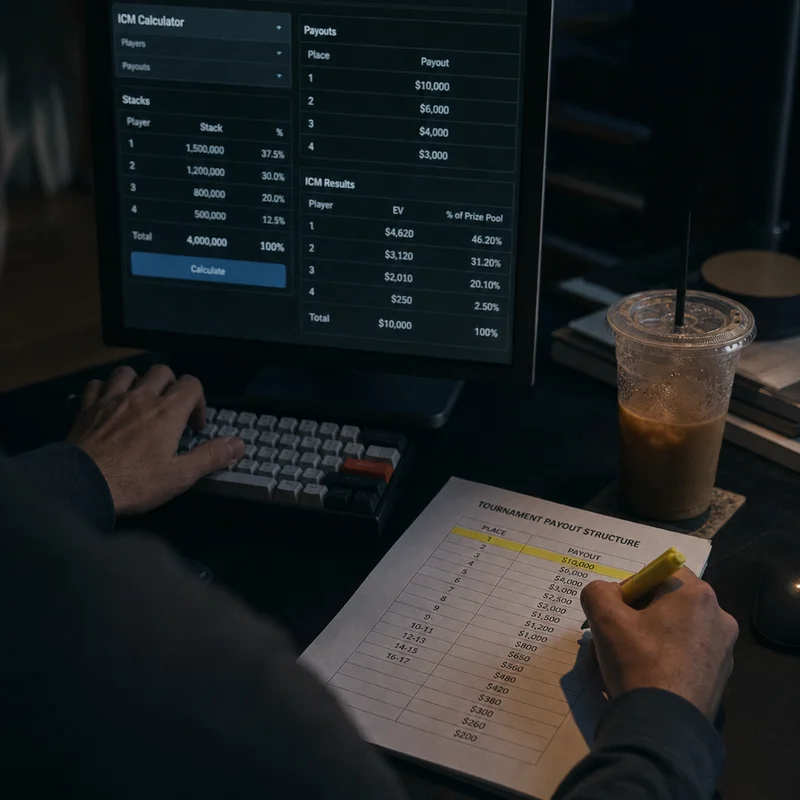
In a cash game, 1,000 chips are worth exactly $10 whether you're up big or crippled. In a sit and go, that same stack buys something different depending on how many players are left and how the payouts are structured. Cash game vs sit and go thinking diverges right there: a cash player calls based on pot odds against a range, while an SNG player has to weigh what those same chips are worth at the next pay jump. I'm not going to walk through the ICM formula here — the ICM page does that properly — but you need to feel the effect even before you can calculate it.

Push-Fold Endgame: Where Sit and Go Strategy Actually Lives
Once stacks drop below roughly 10-12 big blinds, the game stops being about post-flop play and becomes a shove-or-fold decision tree. This is the single-table format's real identity, and it's where most players arrive unrehearsed — not because they can't count chips, but because nobody showed them what those chips buy before the shove and after it lands. A 9-big-blind stack on the money bubble isn't just 9 big blinds. It's a lever against the other short stacks, and the value of that lever changes the moment someone else at the table gets crippled.
Practically, that means widening your shoving range from late position under 10 big blinds, tightening your calling range once you're the one who can bust a shorter stack, and treating the money bubble as the sharpest inflection point in the structure. King-jack offsuit is a clear shove from the button at 8 big blinds in a vacuum — it's a much closer call three-handed on the bubble, where losing the call sends you home with nothing and folding keeps the seat alive for the pay jump.
The Chips-Before-and-After Test
Turbo and Hyper Turbo SNG Strategy: Compressed Decisions
Regular-speed sit and goes give you 15-20 minute levels and something resembling a middle game. Turbo SNG strategy throws that out — blinds jump every 3-5 minutes, and you're at push-fold stack depths by level four or five instead of level ten. Hyper turbo SNG strategy compresses it further still: some hypers start at 500-chip stacks against 10/20 blinds, meaning you could be at 15 big blinds before the first hand is even dealt.
What that buys you is fewer decisions and a table that's already thinking in push-fold terms from hand one. What it costs you is any room to build reads — three-bet bluffs and slow plays that work in a deep-stacked cash game or a level-one MTT just don't have time to develop here. I've played enough volume across both speeds to say the skill gap in turbos is almost entirely a push-fold chart gap: players who know the shove and call ranges cold beat players who are still thinking in post-flop terms, full stop.
Spin and Go Strategy: Lottery Payouts, Different Variance
Spin and go strategy has to account for something regular SNGs don't: the prize pool itself is random. A three-handed hyper turbo where the multiplier lands at 3x plays completely differently from one where the reveal hits 1,200x, because the second scenario means the winner takes an enormous pool and second and third get nothing at all. That changes the calling math on the bubble of a spin and go in a way a fixed, published payout structure never does — you're not just weighing chip value against a known ladder, you're weighing it against a payout that was still unknown thirty seconds before the hand started.
Is spin and go profitable as a format to specialize in? It can be, but the honest answer is that the variance sits well above regular SNGs and far above cash games — three-handed hyper turbos finish in minutes, and a losing stretch can run deep before the sample says anything reliable about your play. That's a variance statement, not an expectation claim; nobody can hand you a win-rate number for a format that swings on a random multiplier, and I wouldn't trust one from anybody who tried.
Cash Game vs Sit and Go: Adjusting Your Instincts
Players who move from cash games into sit and go strategy usually bring one bad habit: calling based purely on pot odds against a range, without asking what the chips are worth at the next payout level. A call that's profitable in raw equity terms can still be the wrong tournament decision because busting costs you a min-cash that was worth protecting. The reverse habit shows up too — SNG-trained players who go back to cash and fold too much, still thinking in survival terms when the only thing that matters at a cash table is the size of the pot in front of them.
Tools built for cash-game leaks — a HUD like Hand2Note or DriveHUD tracking opponent stats across thousands of hands — don't transfer cleanly to single-table formats where you might see an opponent once and never again. Away-from-the-table study tools such as PioSolver or a trainer like GTO Wizard are more useful here, since you can drill push-fold and ICM-adjusted ranges before you sit down. Some players look for in-hand assistance instead — NZT Poker is one option in that category — but real-time assistance sits outside the rules on the club platforms it targets, a different risk profile entirely from a solver studied between sessions.
Building a Sit and Go Strategy That Holds Up
None of this replaces a push-fold chart, and I'd rather you have one open in a second tab than trust memory at 3am on your twentieth game of the day. What the chart won't tell you is the framing: every shove and every call in the endgame is a trade between what your stack buys now and what it buys if the hand goes wrong. Sit and go strategy that only counts chips misses that trade every time. Strategy that counts payout position first gets it right far more often, and that's the entire difference between players who grind SNGs profitably for years and players who cash out even at showdown-heavy tables.
Want In-Hand Odds Support?
If you want a live pot-odds and equity calculator alongside the hand, NZT Poker is one option worth exploring — check the account-risk trade-off first.
See NZT Poker's ToolsDisclosure: This page contains affiliate links. We may earn a commission at no extra cost to you.