
ICM in Poker: Independent Chip Model Explained
A player at your table can be sitting on the same chip count as you and holding money that's worth almost nothing like yours. That's ICM in poker — the independent chip model — and it's the reason a stack's value stops matching its face value the moment a tournament pays out in tiers instead of one winner-take-all pile. I've spent the better part of a decade playing sit-and-gos, where this distortion shows up from the very first hand, and the lesson never stopped being useful: a chip is not a dollar, and the gap between the two is where tournaments get decided. Some players lean on real-time tools for in-hand pot-odds and equity math — NZT Poker is one option built around that — but ICM itself is a separate calculation, and no in-hand tool replaces understanding it. (see poker tournament).

What Is ICM in Poker?
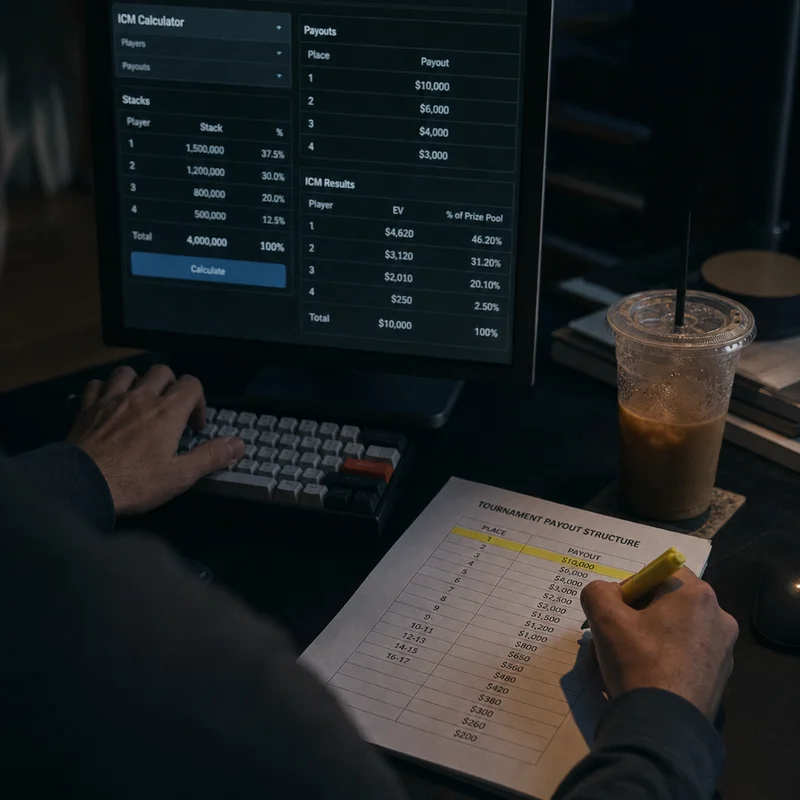
The independent chip model estimates what a tournament stack is worth in real money, given the remaining stacks and the payout ladder, rather than assuming chips convert one-to-one into dollars. You already know payout ladders exist — the model is just the math that sits behind them. It treats every stack size as a share of a finite prize pool, not as a raw chip count, and it recalculates that share after every elimination.
In a cash game, winning 1,000 chips and losing 1,000 chips cancel out exactly. In a tournament with paid places, they don't. Doubling up from 10,000 to 20,000 chips does not double your equity in the prize pool — it adds less than double, because part of what you're now risking is the min-cash you already had locked in. That's the core idea underneath icm poker strategy: your stack's dollar value grows slower than its chip count once real money separates the finishing positions.
How ICM Pressure Reshapes Your Stack's Value
ICM pressure is what happens when the ladder makes some of your chips worth defending and others worth almost nothing to risk. A short stack near the money bubble carries heavy ICM pressure — the min-cash sits close, and busting before it costs disproportionately more than the chips at risk would suggest on their face. A big stack carries a different kind of pressure: those extra chips buy real leverage over shorter stacks, but only if you use them to apply pressure rather than to gamble them off.
This is also where general late-stage tactics and ICM start to overlap without being the same thing. If you want the broader picture of adjusting your game as blinds rise and stacks shrink, that ground belongs to our tournament strategy guide — this page stays focused on the chip-to-money conversion itself.
How to Calculate ICM in Poker
By hand, ICM is a slog. The full calculation runs through every possible order players could bust in and weights each finishing position by probability, then sums the payouts. Nobody does that at the table. What matters practically is the shape of the answer, not the decimal: shorter stacks lose proportionally more value from busting than their chip count implies, and stacks near the top of the ladder gain less from doubling up than the chip count implies.
- Stack sizes for every player still in the tournament
- The exact payout amounts for every remaining paid position
- Your own stack's rank relative to the others at the table
- How many places remain before the money, if you're pre-bubble
Those four inputs are what any ICM calculator needs to produce a number. Icmizer and HoldemResources Calculator are the two most widely used standalone tools for studying spots away from the table — you load a stack distribution, and they return each player's dollar equity. That's a different job from what a live equity or pot-odds calculator does. If you want that kind of in-hand math, NZT Poker's equity tool is one option — useful for the live hand, but it isn't an ICM number, and it won't tell you what a fold is worth in tournament dollars near the bubble.
Don't Trust a Precise Percentage You Haven't Solved
ICM Chops and Deal-Making at the Final Table
An ICM chop is a deal the remaining players make to split what's left of the prize pool according to ICM-calculated equity, instead of playing the tournament out to a single winner. Most rooms and live series that permit deals require the request to go through the floor, and the numbers get generated by the same kind of calculator used for studying stack equity — nobody is negotiating chop numbers from memory.
A chop makes sense when the remaining stacks are close enough, and the players skilled enough relative to each other, that the extra variance of playing it out isn't worth much to anyone. It makes far less sense for the stack with a real skill or size edge — in my view, that player is giving up real equity to lock in certainty, and it's a decision worth being deliberate about rather than agreeing to on reflex because everyone else at the table wants to go home.
Where ICM Overrides Chip EV
Chip EV asks one question: does this play win more chips on average? ICM asks a different one: does this play win more tournament dollars, given what's already locked in? Those two answers split apart hardest right around the bubble and at short-handed final tables, and that split is the entire reason ICM strategy exists as its own subject rather than being folded into ordinary hand-reading.
Take a simple final-table spot: three players left, you're on the short stack, and you're weighing a call that's roughly break-even in chips against a big stack's shove. In chip terms, that's close to a coin flip — call it even money either way. Put the payouts next to it and the picture changes: the min-cash you're guaranteed for finishing third is already yours, and busting to a coin flip converts that guaranteed money into a shot at second and first that pays only modestly more. The chip line says it's close. The cash line says you're often giving up more guaranteed value than the extra prize money is worth. That gap between the two lines, not the chip count itself, is what should be driving the call.
If you're specifically looking for how to apply that gap to stealing and defending right at the money bubble, that's covered in depth on our bubble strategy page. What matters here is the general principle: the closer the payout jump, the harder ICM pulls against a chip-EV-only decision.

ICM Strategy: Adjusting Your Preflop Ranges
ICM preflop ranges tighten almost everywhere except one seat: the biggest stack at the table, who can use size as a weapon against players protecting a min-cash. Medium stacks tend to narrow the most, since they have real money at risk but not enough leverage to push anyone else around. Short stacks often widen again once they're committed anyway — folding equity matters less when calling or shoving is close to your entire stack regardless.
This is where icm gto poker study tools earn their keep, and I think they're underused. A solver-based trainer like GTO Wizard builds ICM payout structures directly into its tournament modules, so you can review a shove-fold spot away from the table and see how the correct range shifts as the payout jumps get bigger. That's a genuinely different tool from anything built for in-hand use — the value is in repetition and review, not a suggestion mid-hand.
- Studying ranges with an ICM-aware solver builds pattern recognition you keep after the session ends
- Running actual numbers through a calculator catches spots where your gut instinct is wrong
- A real payout ladder in front of you makes late-stage decisions far less emotional
- Solver study takes real hours away from the table to pay off
- ICM calculators need accurate stack and payout inputs, and bad inputs produce a confident but wrong answer
- Over-relying on ICM logic can make you too passive against players who aren't respecting it either
Building ICM Instincts Over Time
I never trusted a number I hadn't run, and I'd tell any player the same thing: use the calculators, review the spots afterward, and let the pattern build slowly rather than trying to eyeball dollar equity live. The instinct comes from repetition against real payout ladders, not from memorizing a chart. Books like Kill Everyone go deep on the math side if you want the full derivation; a working ICM calculator alongside a hand history review habit will get most players further, faster.
Want Live Pot-Odds Math at the Table?
If you want in-hand pot odds and equity worked out live, NZT Poker is one option worth exploring alongside solver-based study.
Explore NZT PokerDisclosure: This page contains affiliate links. We may earn a commission at no extra cost to you.